
Oyang Sikgwan, pork kimchi stewGwanghwamun’s Office Hideout
A basement dining room behind the newspaper offices, two hundred seats, and one pot of pork and kimchi on almost every table.
By JISUP SHIN · 오양식관 · Sejong-daero 21-gil, Jung-gu ·
Gwanghwamun is office country. Ministries, newspapers, banks, insurers — the whole stretch of Sejong-daero between the palace and City Hall empties onto the pavement a few minutes before noon, and every one of those people has an hour and an opinion about where to spend it. 🍲
The day before the Chuseok holiday began, we had a team lunch. It was not on the company — everyone was paying for their own — and with prices in Seoul what they are now, that matters. Luckily one of us already had a place in mind: somewhere cheap and good they had been meaning to try. 🌕
오양식관, Oyang Sikgwan. Hearing the name for the first time, I thought it sounded hopelessly old-fashioned. 🤔
But Oyang rang a bell. When I was a child, Oyang meant crab sticks: say imitation crab in Korea and 오양맛살, Oyang Matsal, was the brand that came to mind. The company that made it has since been absorbed into the Sajo group and survives only in the name Sajo Oyang. The building we walked down into seems to have been one of Oyang’s. 🦀
We went down the stairs a little before twelve, to beat the crowd. It was already half full. 👀
Where it is
There are two, both in the middle of old Seoul. The one we went to is the original on Sejong-daero 21-gil: a short walk from Gwanghwamun Square in one direction and Deoksugung Palace in the other, which makes it an easy lunch to fit into a day of sightseeing. In December 2018 a second shop opened on Jong-ro 11-gil near Jonggak Station, at the top of Insa-dong — the closer of the two if you are spending the day there. 📍
- Oyang Sikgwan, main shop 오양식관 ★49 Sejong-daero 21-gil, Jung-gu · B1 of the Oyang building · Mon–Fri 10:00–22:00, break 14:00–16:00, last order 20:30 · Sat 10:00–20:30, no break · closed Sun · Gwanghwamun Stn (Line 5) exit 6, about 3 min · ☎ 02-732-8088Google directionsNaver map
- Oyang Sikgwan No. 2 오양식관 2호점11 Jong-ro 11-gil, Jongno-gu · B1 · opened December 2018 · Mon–Fri 11:00–22:00, break 14:30–16:00, last order 21:30 · Sat 11:00–21:00 · check Sundays before you go · about 4 min from Jonggak Stn (Line 1) · ☎ 02-737-8088Google directionsNaver map
★ the shop in this journal — the photographs, menu and walking map below are all from the main shop. Hours are taken from the sign on the door and from listing platforms; at the main shop the evening-only dishes start at 16:00, when the break ends.
Oyang Sikgwan
식관, sikgwan, is an old-fashioned word for an eating house — the kind of name a place gets when it was never meant to be a destination, just the canteen for everyone upstairs and next door. Which is probably why it sounded so dated.
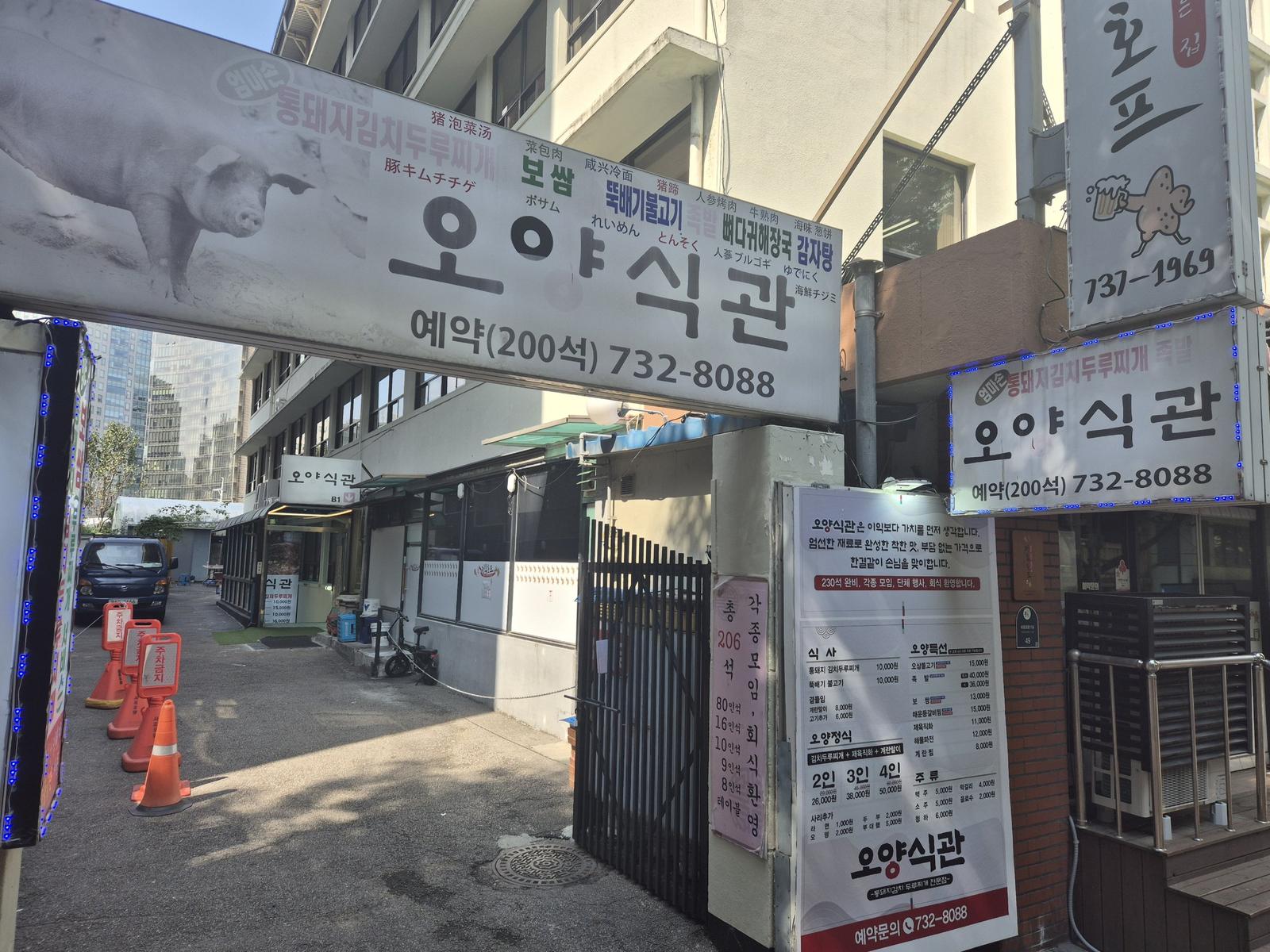
The sign over the driveway tells you most of what you need. A pig. The words 엄마손, “mother’s hands,” which in Korean restaurant language means home cooking. The stew, 통돼지김치두루찌개. And the dishes listed again in Chinese and Japanese, because the tourists found it some time ago.
Nobody can agree on the size of the room, either. The street sign says 200 seats, the pink banner by the gate says 206, and the menu board at the entrance says 230. Whichever is right, it is a lot of seats for a basement — and at 12:15 on a weekday you will still see people waiting for one.


Every table has a gas burner set into the middle of it, and that tells you how the meal works. The stew does not come out of the kitchen in a bowl. It comes in a wide, dented aluminium pot, raw and cold, and it cooks in front of you.
The rest of the room is pure office canteen: pale panelling, a fan on every pillar, a calendar by the till, coats and bags hung on hooks along the wall. It is not a place to linger. It is a place to eat well in forty minutes and get back to your desk. ⏱️

Korean food television has been here, of course. In March 2024 the MBN show Jeon Hyun-moo Plan sent its presenter and the YouTuber Kwak Tube around Gwanghwamun asking passers-by where they ate lunch. Enough of them said this place that the crew turned up at nine in the morning, and the owner let them film anyway. 📺
The poster from that episode hangs by the door. Its tagline is roughly “the textbook pork kimchi stew,” which is about right. This is not a clever kimchi stew. It is the standard one, done properly.

What the name on the pot means 🐖
Break 통돼지김치두루찌개 into its parts and it describes the dish exactly. 통돼지, tongdwaeji, is “whole pig” — pork in big, fatty chunks rather than the thin shreds most kimchi stews use. 김치 is the kimchi. And 두루찌개 is the house’s own word, a cross between 두루치기, a pork-and-kimchi braise cooked nearly dry, and 찌개, a stew.
That is how it eats. It arrives thicker than a normal kimchi stew, heaped with pork and cabbage and onion in a red, oily broth, and it loosens as it boils.
At home I often make pork kimchi stew with plenty of pork shoulder. Simmer good pork until it is soft, then cook the stew down a little, and you have my favourite kimchi stew. This tastes exactly like that. The key ingredient is kimchi that has gone well past fresh — properly sour — and they seem to be using well-fermented kimchi here too. 🥬
With pork this good, I wanted more of it the whole way through — and it turns out the board has 고기추가, extra pork, at ₩6,000. Next time I am ordering it from the start. 🥩
The sign on the wall makes the same two promises: the kimchi is made and aged in-house, and the pork is Korean-raised, grade-1 sow meat. The grading certificate is pinned up above the coffee machine, if you want to check.
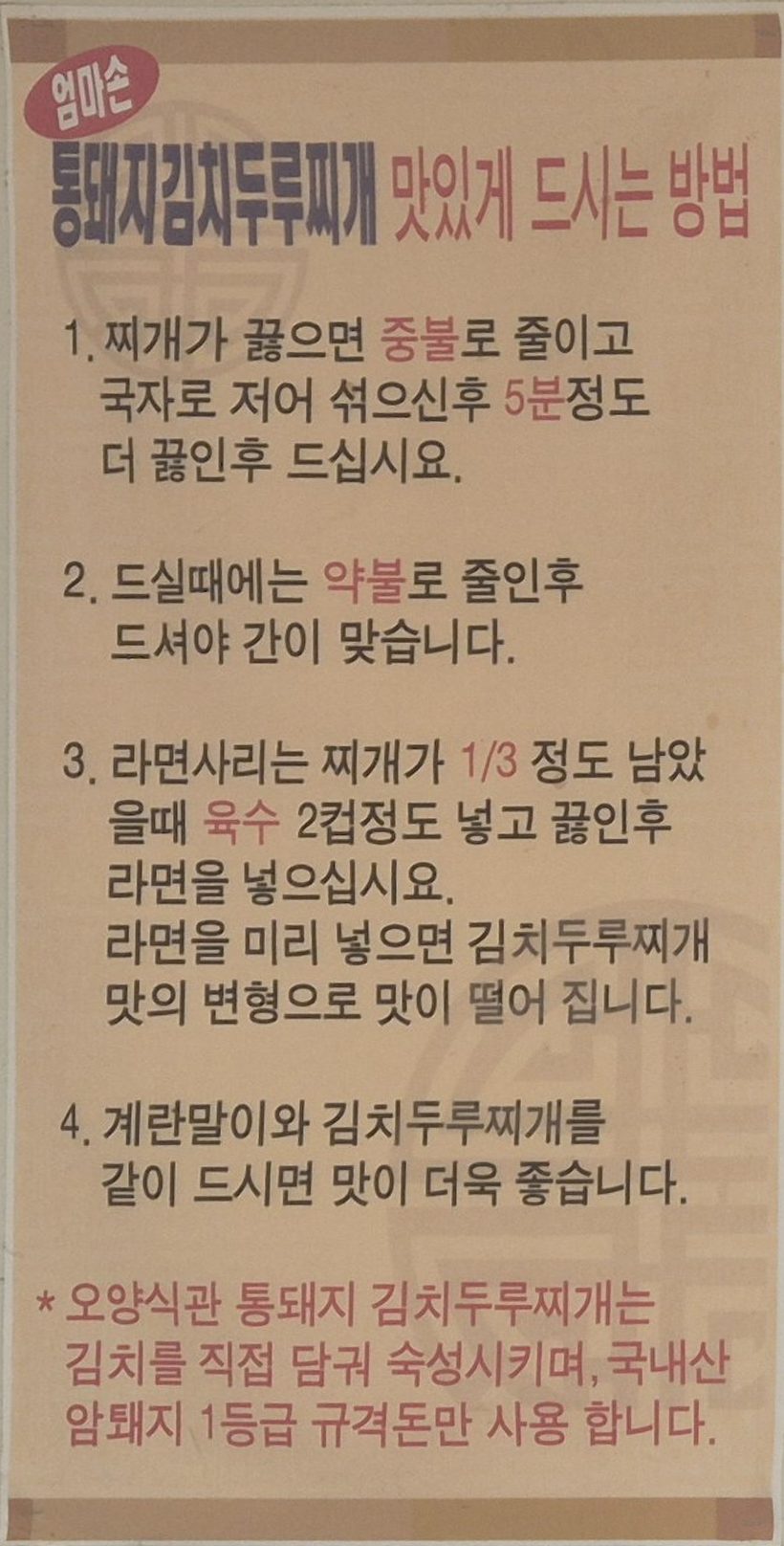
You are not left to guess how to cook it. There is a sign on the wall — 맛있게 드시는 방법, “how to eat it well” — and the staff will point at it if you look lost. It runs to four rules. 📝
- When it boils, turn the flame down to medium. Stir it with the ladle and give it five more minutes before you start.
- While you eat, keep it on low. Let it keep boiling hard and it over-reduces; the seasoning is set for a gentle simmer.
- Ramen goes in when a third is left. Add about two cups of stock first, bring it back to the boil, then the noodles. Put them in early and, the sign says, the stew stops tasting like itself.
- Eat it with the rolled omelette. Their words, not mine — and they are right.
The set 🍳
You can order the stew on its own, at ₩10,000 a head. Almost nobody does. The thing to order is 오양정식, the Oyang set: the stew, a plate of 제육직화, and a 계란말이, priced by the number of people at the table. Two cost us ₩26,000.
It is the combination that made the place, and it is not an accident. Kimchi stew is sour and hot. The pork is sweet and hot. The omelette is neither — it is soft, bland, faintly salty, and it is there to cool your mouth down between the other two. 🥚
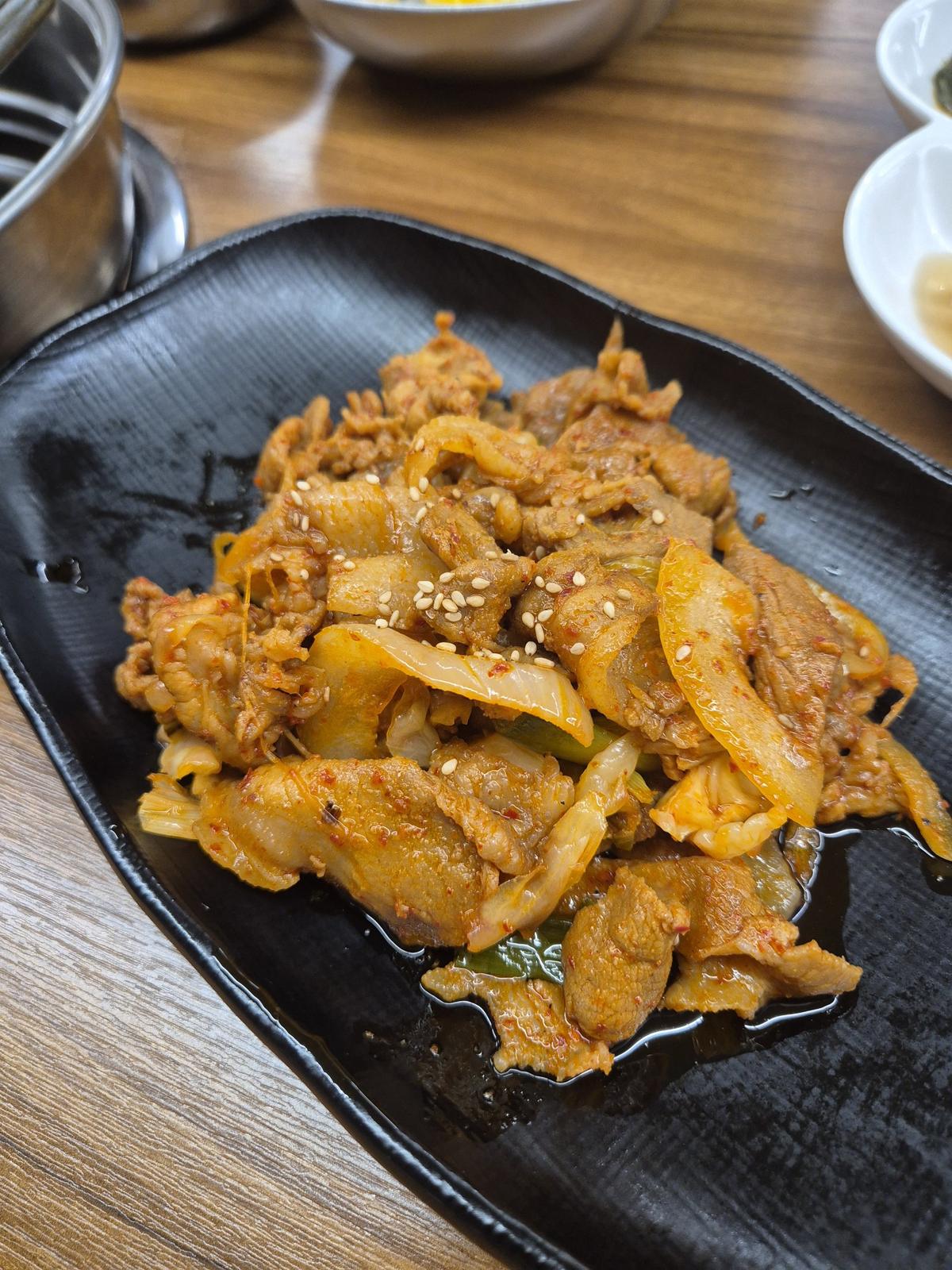

This is what two people get. The pot on the burner, still lidded; the pork; the omelette; a clover-shaped tray of four small side dishes — pickled radish, seasoned greens, sweet pickled chillies, bean sprouts — a dish of 쌈장; a basket of lettuce; two steel bowls to ladle into.
And at the side, the yellow packet: 라면사리, a block of instant noodles, ₩1,000. It sits there waiting for the last third of the pot. 🍜
What it cost us
The set for two, one block of ramen, and as much rice and lettuce as we wanted from the self-bar: ₩27,000, or ₩13,500 each. 💸
That is not cheap by the standards of a Korean canteen, where a bowl of kimchi stew alone still goes for less than ₩10,000 in plenty of places. But you are paying for the pork, of which there is a great deal, and for a table that fills up the moment you sit down. In this part of town, for this much food, it is a fair price — which is why the office crowd keeps coming.
Help yourself
Rice is not on the menu because it is free. So is everything else you might want more of. 🍚
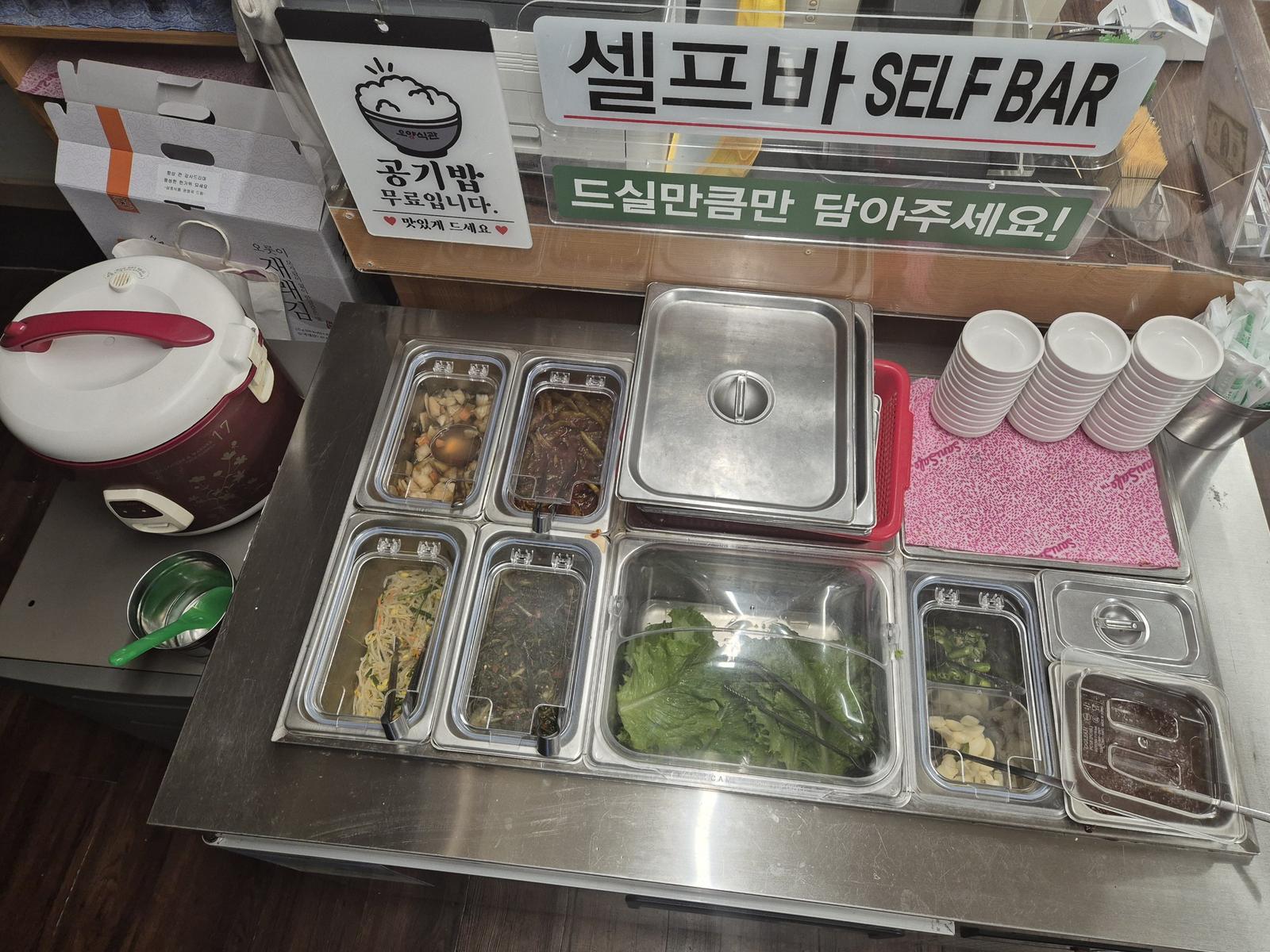
By the counter there is a 셀프바, a self-service bar: a rice cooker, lettuce, raw garlic, sliced green chilli, 쌈장, and refills of every side dish on your tray. The sign on the rice says 공기밥 무료입니다 — “a bowl of rice is free” — and the one above the tubs says 드실만큼만 담아주세요, “only take what you will eat.”
Take a stack of little dishes from the pile on the right and fill them yourself. Nobody will bring more to the table; that is what the bar is for. 🥗
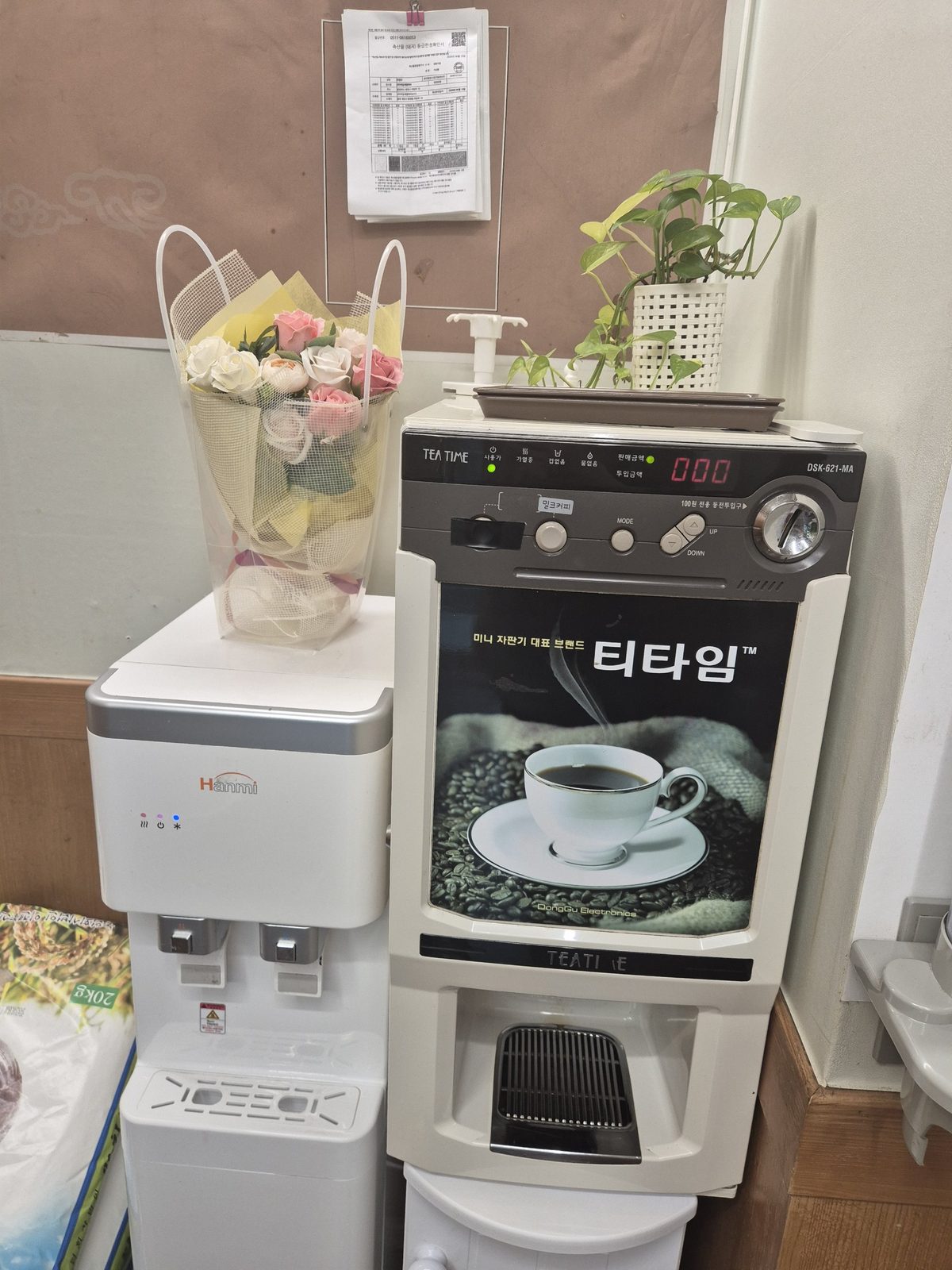
At the end of the meal, do what the office workers do and go to the corner by the water dispenser. The little machine there is a 자판기, a vending machine, and it makes one thing: 밀크커피, sweet instant coffee with milk powder, dropped into a paper cup. It takes 100-won coins. ☕
It is not good coffee. It is exactly the right coffee after a kimchi stew, and a whole generation of Korean office workers will tell you so. Look up while you wait for the cup: the pork grading certificate is clipped to the wall right above it.
If you want a drink with it — at lunch most people don’t, but after four most people do — the fridge by the kitchen holds the usual Seoul line-up: Chamisul, Jinro, Saero and Cheoeum-cheoreom soju, Terra and Krush beer. Soju and beer are ₩5,000 a bottle. 🍺

A Seoul lunch hour
If you want to see how Seoul’s office workers actually eat, come at noon on a weekday, sit down, and watch the room. A few words will help you follow it. 🕛
- 점심시간 jeomsim-sigan
- Lunch hour, and in Korea it is nearly always twelve to one. Everyone leaves at once, everyone comes back at once, and a restaurant like this does most of its day’s trade in those sixty minutes. Arrive at 11:40 or after 12:50 and you will walk straight in.
- 직장인 jikjangin
- Office worker. You will see the word on television posters and restaurant signs all over this district — “the office worker’s soul food,” “the office worker’s favourite lunch.” It is a recommendation: food that is quick, filling, fairly priced and the same every time.
- 김치찌개 kimchi-jjigae
- Kimchi stew, the most ordinary dish in the country and the one Koreans argue about most. Every household and every restaurant makes it differently, and everyone thinks theirs is the best.
- 공기밥 gonggi-bap
- A bowl of rice, the steel kind with a lid. In most restaurants it is ₩1,000 extra. Here it is free and you serve yourself.
- 사리 sari
- Anything you add to a stew already on the table: instant noodles, glass noodles, rice cakes, fish cake. Ramen 사리 is the default, and it always goes in last.
After the stew
🚶You are in the middle of old Seoul, and everything below is under ten minutes on foot.
Around the corner
- Gwanghwamun Square 광화문광장5 min, 380 m Up to the end of the street and turn left. The statues of Admiral Yi Sun-sin and King Sejong stand in the middle of the road, with Gwanghwamun Gate and Gyeongbokgung Palace at the far end and Bugaksan behind them.
- Kyobo Book Centre 교보문고 광화문점6 min, 470 m Across the square, under the Kyobo building: a vast bookshop that takes up most of a basement floor, with a good foreign-language section and a stationery hall. Busy, air-conditioned and free, which on a hot afternoon counts for a lot.
- Cheonggyecheon 청계천6 min, 420 m The restored stream begins at Cheonggye Plaza, just across Sejong-daero, under Claes Oldenburg’s giant striped shell, Spring. Take the steps down and walk east along the water.
- Seoul Anglican Cathedral 서울주교좌성당3 min, 170 m At the other end of the same street: a Romanesque church in red brick and grey stone, with a Korean tiled roof, built in the 1920s. The quietest courtyard in the neighbourhood.
- Deoksugung 덕수궁7 min, 530 m The palace where old Korean halls and Western stone buildings stand in the same garden. The guard-changing ceremony runs in front of Daehanmun Gate several times a day, and the stone-wall walk along the palace’s west side starts round the corner. Closed on Mondays.
Walking times are from the restaurant’s door, measured along the streets. Map data © OpenStreetMap contributors.
Before you go
The things people ask before they walk down the stairs.
What should I order at Oyang Sikgwan?
The Oyang set: whole-pork kimchi stew, flame-cooked spicy pork (jeyuk) and a rolled omelette, priced by the number of people — ₩26,000 for two. Add a block of ramen (₩1,000) when about a third of the stew is left.
Does Oyang Sikgwan have more than one branch?
Yes, two. The main shop is in the basement at 49 Sejong-daero 21-gil near Gwanghwamun. A second shop opened in December 2018 at 11 Jong-ro 11-gil, near Jonggak Station and Insa-dong.
When is the best time to go?
Before 11:45 or after 12:50 on a weekday, when the office lunch rush is either not yet in or already gone. Saturday is quieter and has no break. It is closed on Sundays, and on weekdays it closes between 14:00 and 16:00.
Can one person eat here?
Yes. The stew and the earthenware-pot bulgogi are ₩10,000 each and are served per person. The Oyang set starts at two people, as do some of the evening platters.
Is there an English menu?
No — the board is Korean only, though the sign outside lists the main dishes in Chinese and Japanese. Pointing works: say 오양정식 두 명 (oyang jeongsik du myeong) for the set for two.
Can you pay by card?
Yes. The door has stickers for UnionPay, American Express, WeChat Pay and Zero Pay, and Korean cards and mobile payments are taken at the counter.
How spicy is it?
Medium, by Korean standards. The stew is more sour than hot, the pork is sweeter than it is spicy, and the rolled omelette and free rice are there to calm things down. If you are nervous, add tofu or ramen to the pot.
Can we book?
For groups, yes — ring 02-732-8088. The room is large and takes company dinners in the evening. For two people at lunch, just turn up.
Notes
All photographs and video are my own, taken at the restaurant on 23 September 2026. Last updated .
- Prices and menu — read off the wall banner on our visit, September 2026
- Hours — the sign on the door, and listing platforms; the shop does not publish its own
- Street map — drawn from OpenStreetMap data, © OpenStreetMap contributors, ODbL
- Television appearance — MBN, Jeon Hyun-moo Plan, broadcast March 2024
- Nearby, on this site — Watching the Office Eat: Maknae Hoetjip, Jongno, a sashimi house ten minutes’ walk away
Prices, hours and the evening menu all move. Treat everything here as a starting point rather than a timetable.

