Buy it, then eat it · Noryangjin Fish MarketAutumn Shad, and Grilled Prawnsfeat. striped jack
Pick from the tank, choose a platter off the menu board, then sit down upstairs at a restaurant that serves what you bought. Autumn gizzard shad sashimi, salt-grilled prawns, spicy fish stew and makgeolli — and afterwards, across the river.
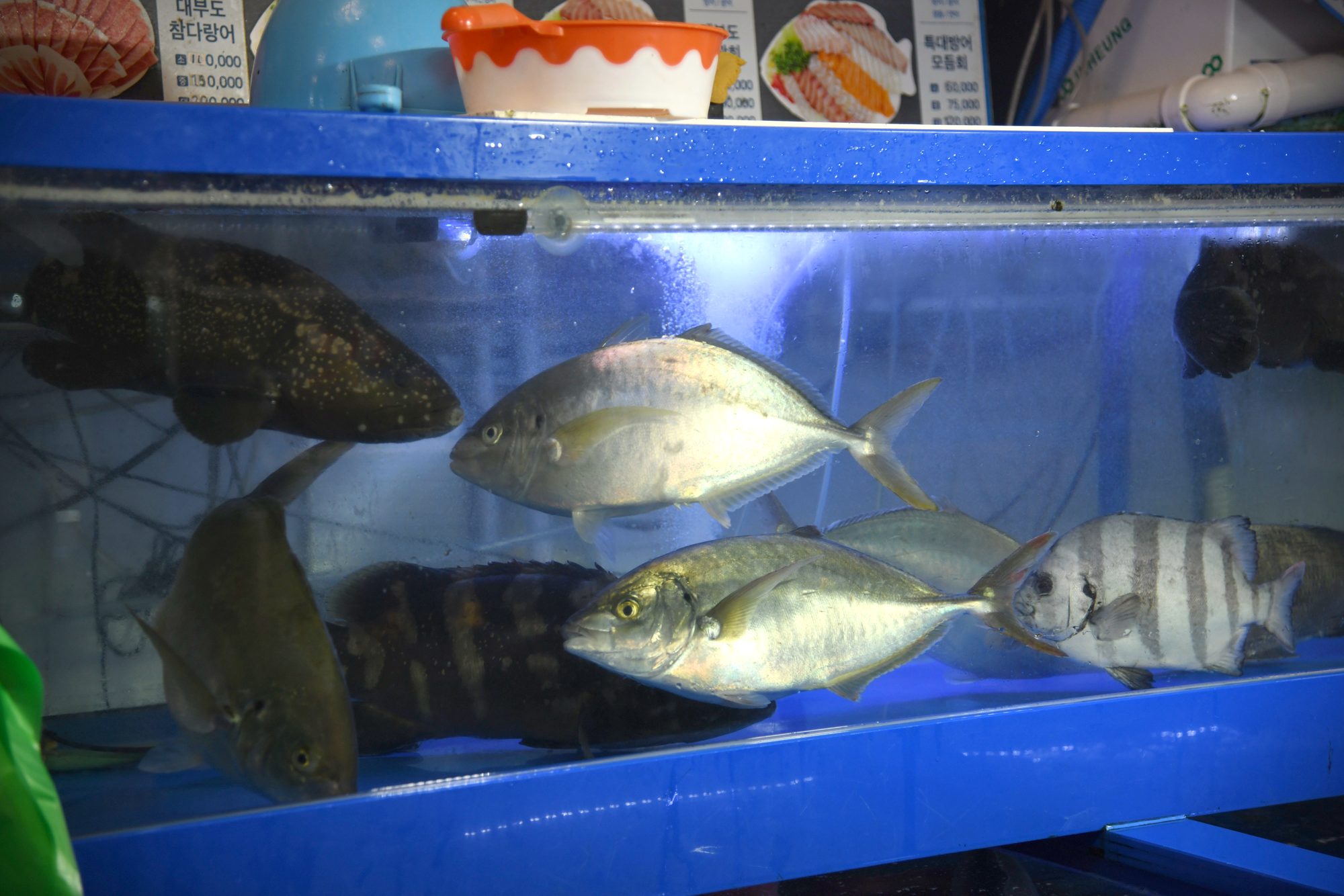
Noryangjin Fish MarketA tank with striped jack · Words & photos JISUP SHIN ·
There is a Korean saying: the smell of autumn gizzard shad on the grill brings even a runaway daughter-in-law back home (가을 전어 굽는 냄새에 집 나간 며느리도 돌아온다). That is how rich autumn shad is. Come September, Koreans start talking about 전어jeoneo so as not to miss its short season. 🍂
In early October we had that meal at Noryangjin: a mixed sashimi platter built around shad, prawns grilled on salt, and makgeolli. The previous post was about choosing at the tanks; this one is what comes next — buying, sitting down and eating.
There was no shad in the tanks that day. The catch had been poor the day before, they said.
This post shows the menu board of a partner shop.
01 · Sashimi
Reading the shad platter
Sea breamspringJacksummerSea basssummerShadautumnFlounderautumn–winterSalmonall year
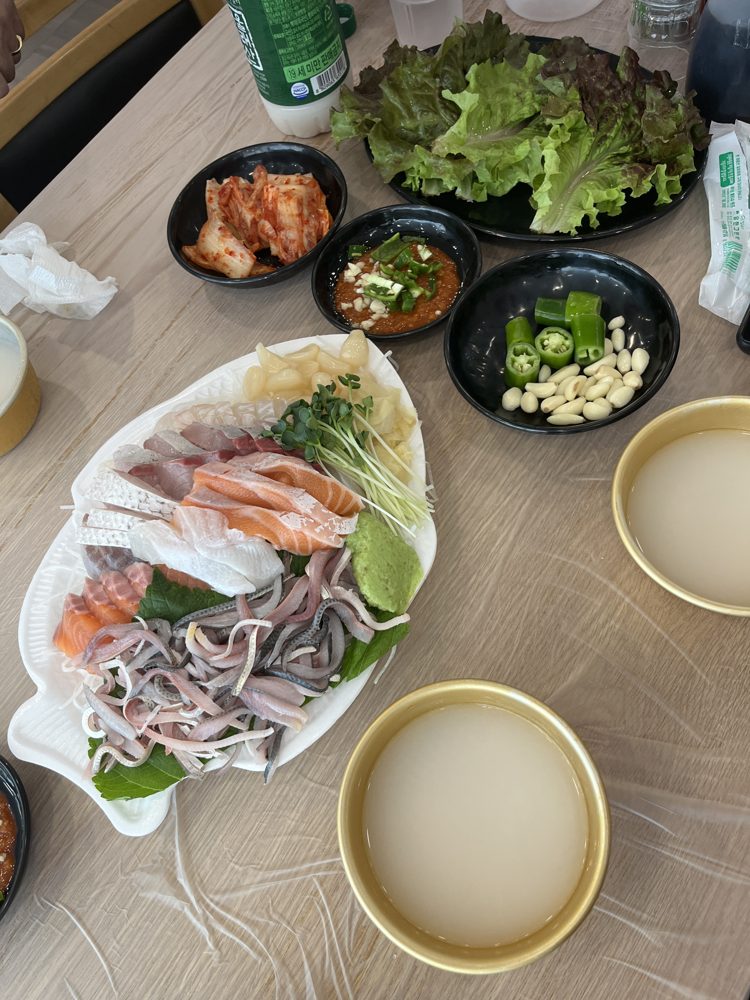
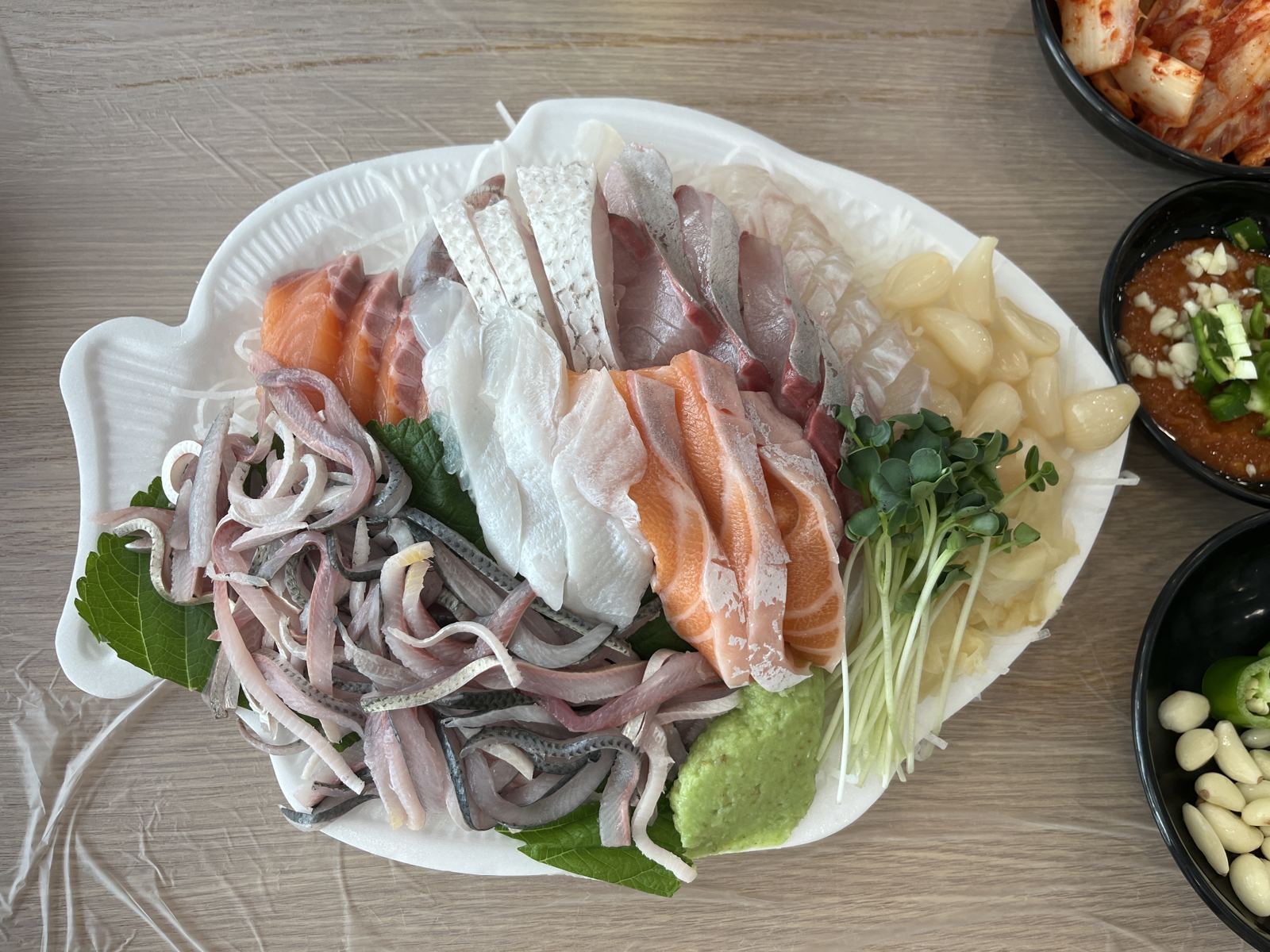
Shad platter, small (serves two, ₩70,000). Dots mark where each fish sits; under each name is its season. Salmon is mostly imported or farmed, so no season is given.
When the platter arrives, your eye goes to the pile of silver stripes at the bottom left. That is the shad, 전어. Shad is full of fine bones, so it is served 세꼬시sekkoshi — sliced thin, bones and all. The silver skin and the blue stripes along the back stay on.
I think shad is best cut differently as the season moves. Around September, bone-in sekkoshi is the way to eat it. Once October comes, sekkoshi is still good, but I prefer the bones taken out and only the flesh sliced thin, or a skinned fillet (오로시oroshi) scored with the knife. That is purely my own taste.
The rest follows the name tags outside the photo. The firm white flesh with its skin pattern still on is sea bream; the silver skin with a red streak of blood-line is jack; the clear white flesh at top right is sea bass; the wide white slices across the middle are flounder; the orange is salmon. The menu board listed five fish — 전어 · 대광어 · 대농어 · 대참돔 · 연어, shad, large flounder, large sea bass, large red sea bream and salmon — and the platter came with jack added.
Shad tastes richest in autumn, when it has put on fat. There is another saying, an autumn shad’s head holds three measures of sesame (가을 전어 대가리엔 깨가 서 말), and it is not for nothing. Whoa — but the striped jack was ridiculously good too.
Buy sashimi and wasabi, 락교rakkyo (pickled shallots) and radish sprouts come free with it. The free wasabi has got much better lately. It is the pale green lump at the bottom of the plate.
How to eat it is simple. Wrap a slice of fish in lettuce or a perilla leaf with radish sprouts, garlic and 쌈장ssamjang, and it makes a truly great mouthful. It is worth asking the restaurant whether they have perilla leaves (깻잎). With oily fish like shad or jack, perilla suits better than lettuce.
If shad’s strong flavour is new to you, alternate it piece by piece with the flounder or sea bream.
The shad platter on the table setting. Lettuce and perilla leaves, garlic, chojang and ssamjang come with it. Makgeolli was ordered separately.
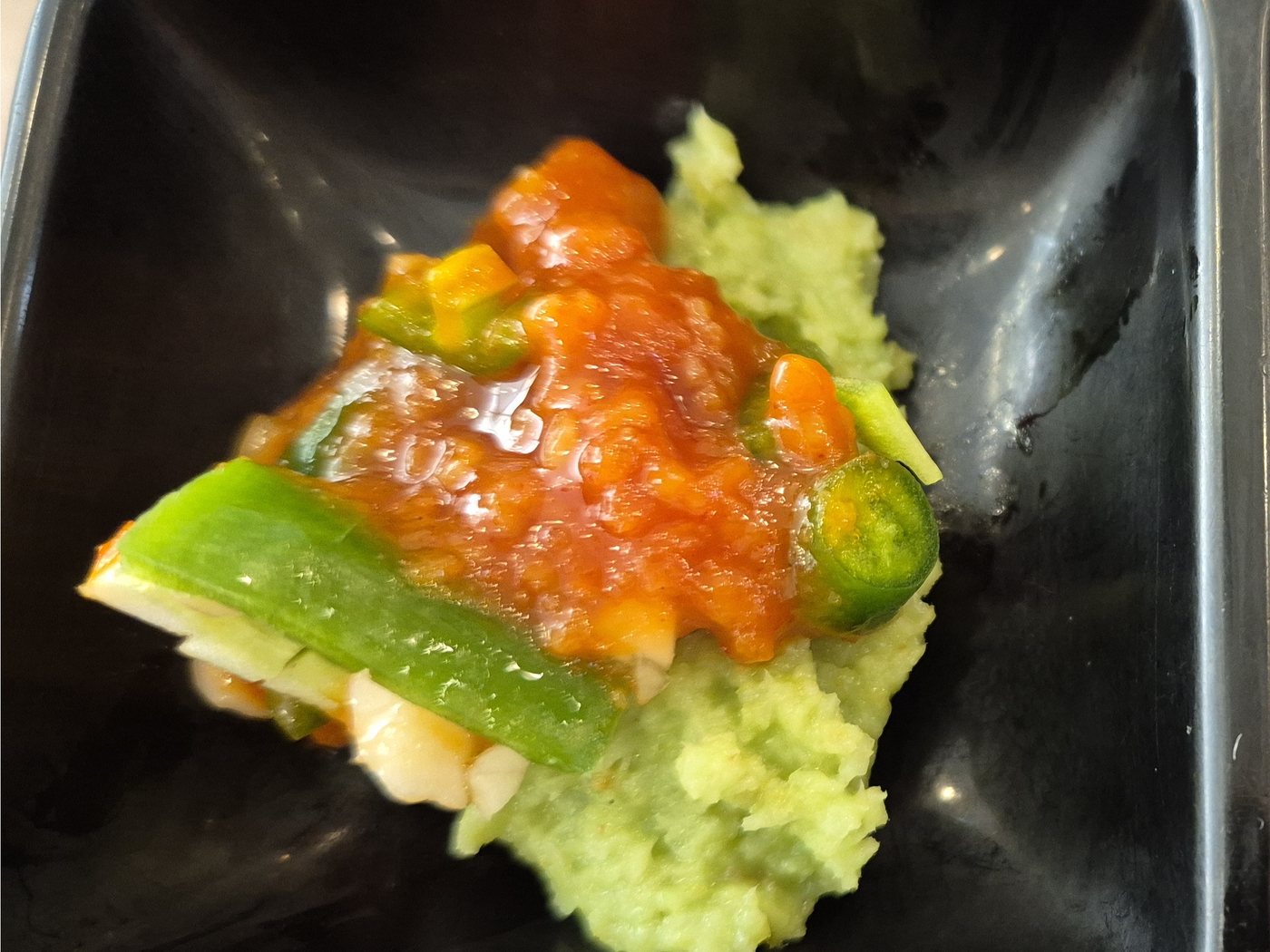
The magic sauceMix wasabi with ssamjang and add a little chilli or garlic. It becomes an unbelievably good sauce for raw fish. Don’t dunk the fish in it — rest the slice lightly on top of the sauce, then eat. Honestly, I like the fish’s own taste, so I skip the wrap and just touch each slice to this magic sauce.
The magic sauce: wasabi mixed with ssamjang, plus a little chilli and garlic.
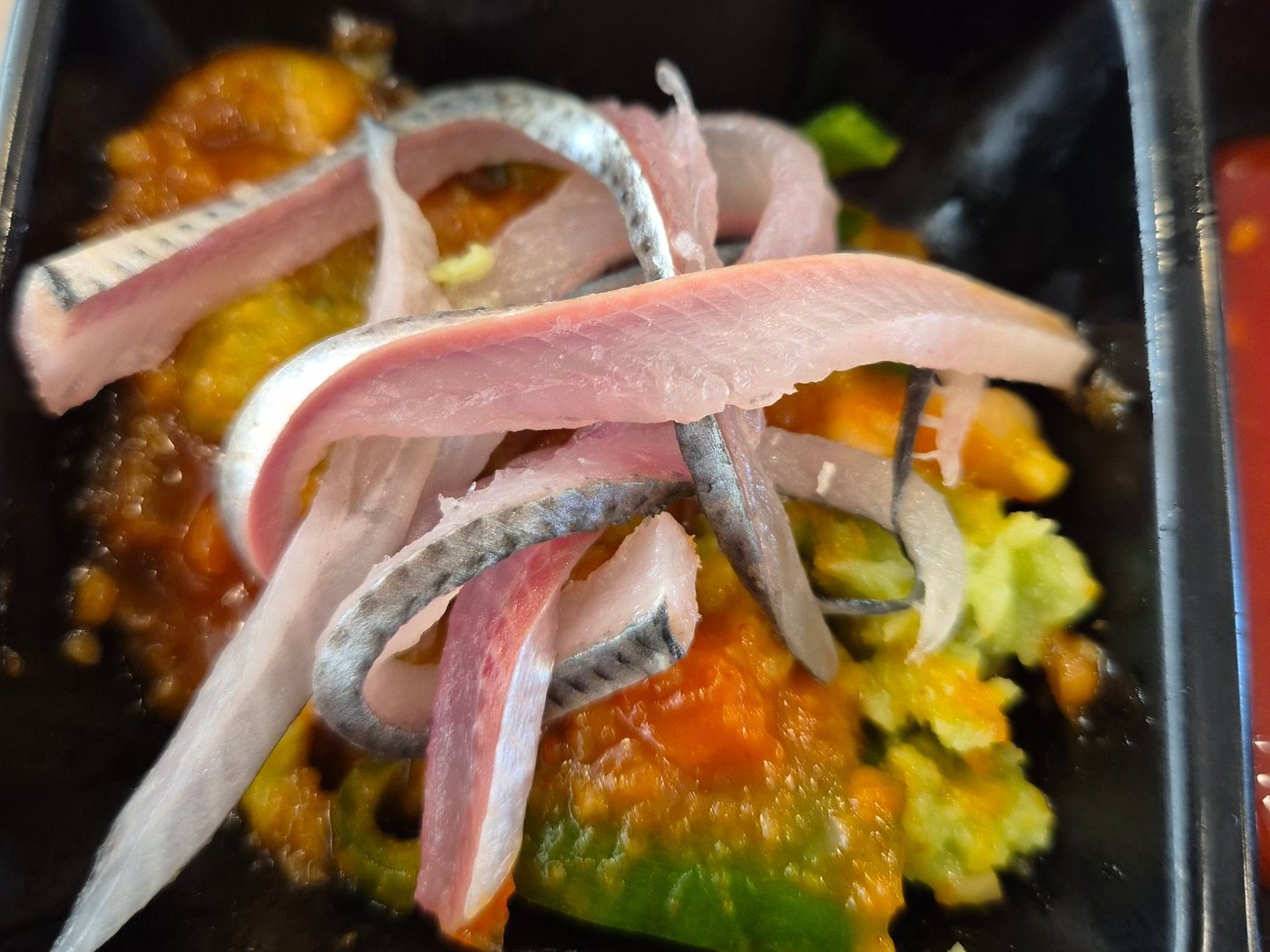
Rest the shad lightly on the sauce, then eat. No dunking.
02 · The menu board
Choosing off the menu board
Noryangjin used to be notorious for overcharging. I love fish, so I came here often, even before the market moved into its current building. Back then, when I looked at shrimp and shad at one stall and bought them at another, some sellers would swear at my back. Once I only asked a price, and the seller scooped the fish straight out of the tank and killed it so that I had no choice but to buy it.
인어교주해적단 — Tpirates in English — is what largely put an end to that. It publishes the day’s prices at fish markets across Korea and advertises fixed-price sets made with its partner shops. The shops get the advertising; customers know the price in advance and can buy with confidence. These days you can buy at Noryangjin at a fair price, too.
How to use itOn the Tpirates website, tpirates.com, or its app, choose Noryangjin Fish Market and find the partner shops on 1F and 2F. Once you find a price you like, follow that shop’s floor and stall number. Every shop stocks very different fish, so find the right one. If you have seen the photo and price of the fixed-price set beforehand, you only need to point at the same platter on the menu board in front of the shop. It also helps to say you came because of the app.
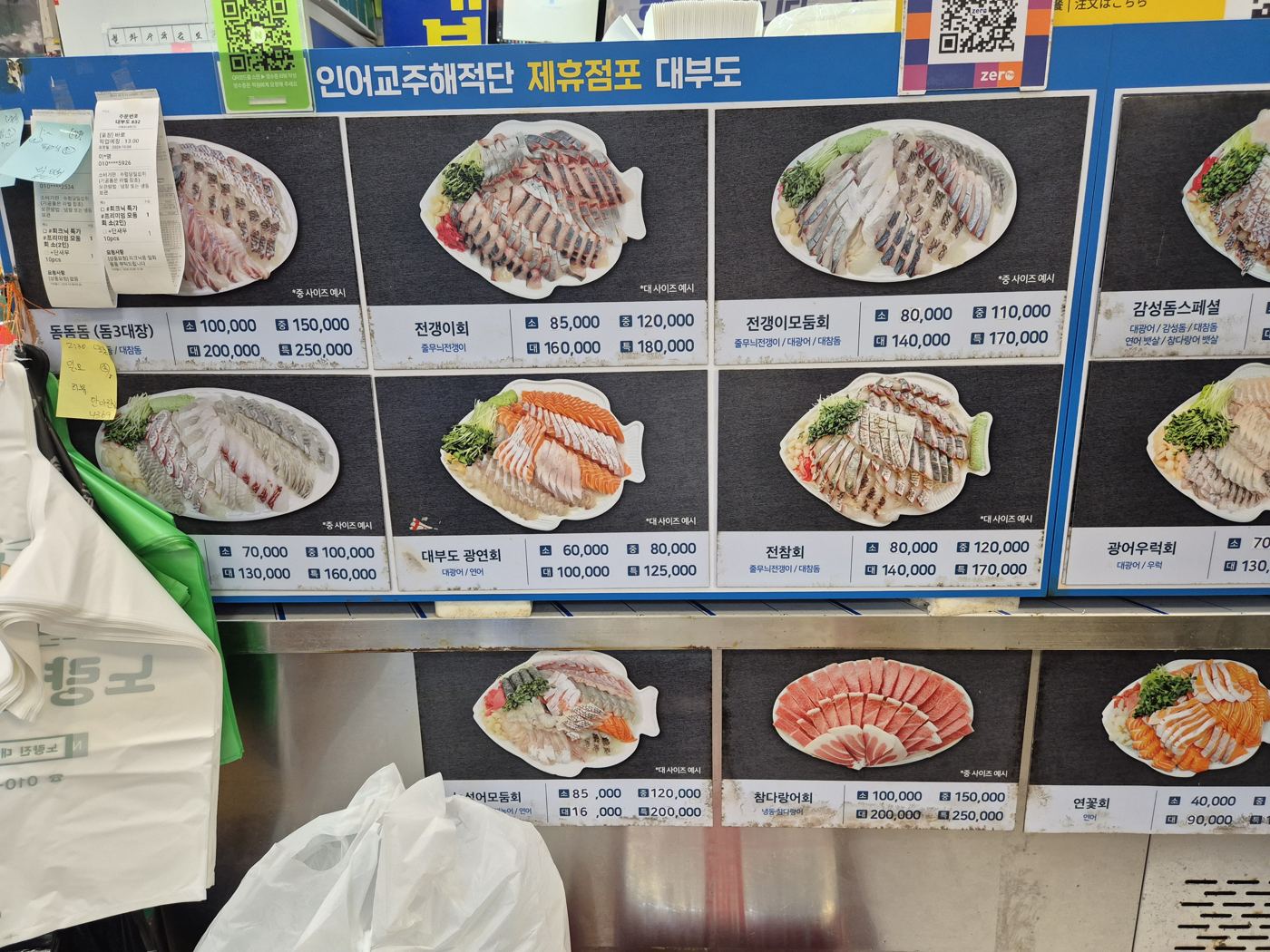
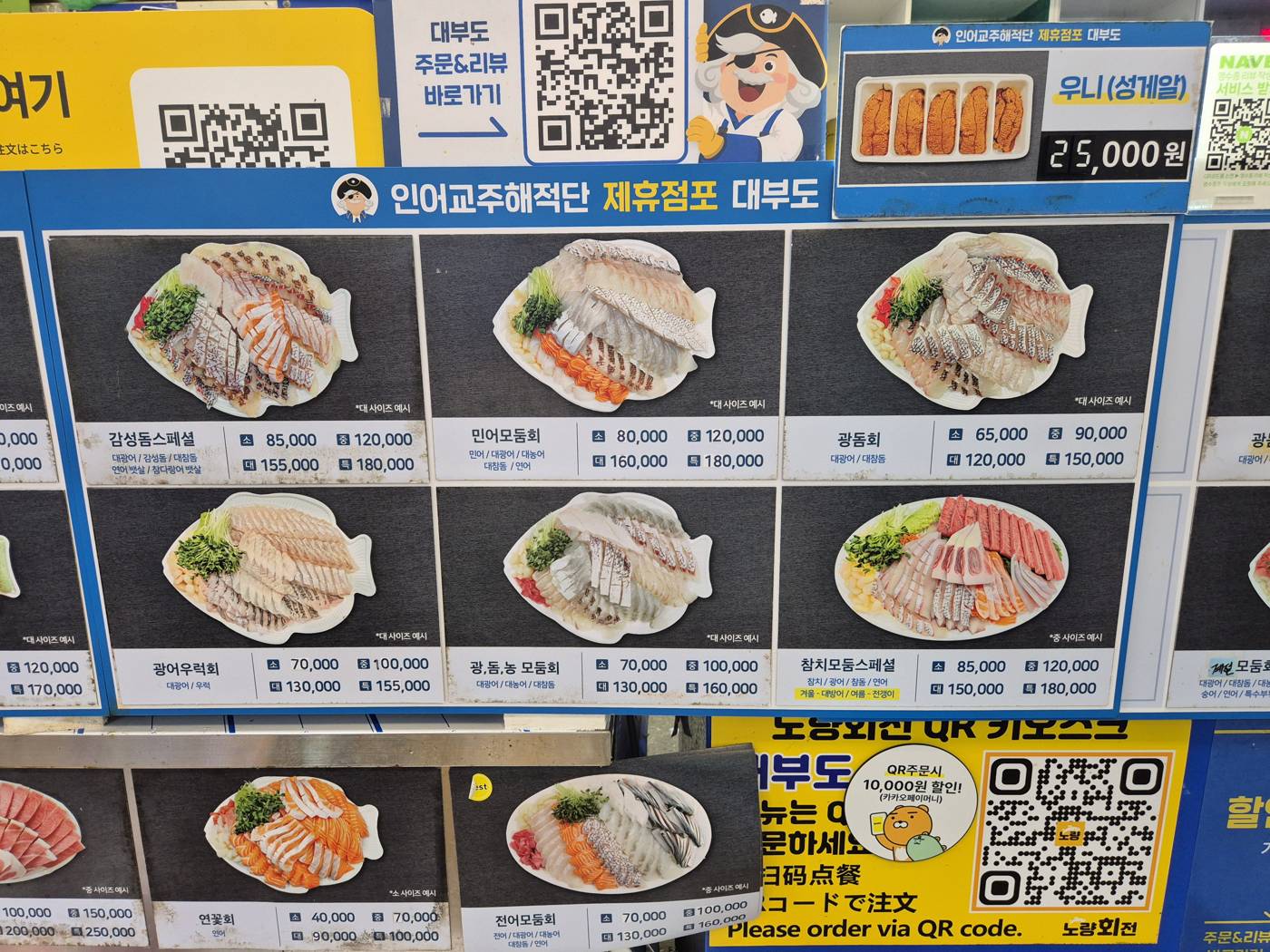
I chose from the menu board of a shop with the Tpirates partner sign. Sizes and prices sit right on top of the photos, so it is easy to choose even if you can’t read Korean.
One panel of the menu board. Under each platter photo are prices in four sizes: small, medium, large and extra large.
The next panel has the brown croaker platter, flounder and sea bream, salmon and the shad platter.
Jack platter 전갱이모둠회striped jack · flounder · red sea bream
80,000
110,000
140,000
170,000
Flounder & rockfish 광어우럭회
70,000
100,000
130,000
155,000
Flounder & sea bream 광돔회
65,000
90,000
120,000
150,000
Brown croaker platter 민어모둠회
80,000
120,000
160,000
180,000
Lotus platter 연꽃회salmon, laid out like a lotus
40,000
70,000
90,000
100,000
Copied off the menu board in early October 2026. Small (소) serves two. Photos show the size; prices change often. The shop also had a notice offering ₩10,000 off when you order by QR code and pay with KakaoPay Money.
03 · Grilled
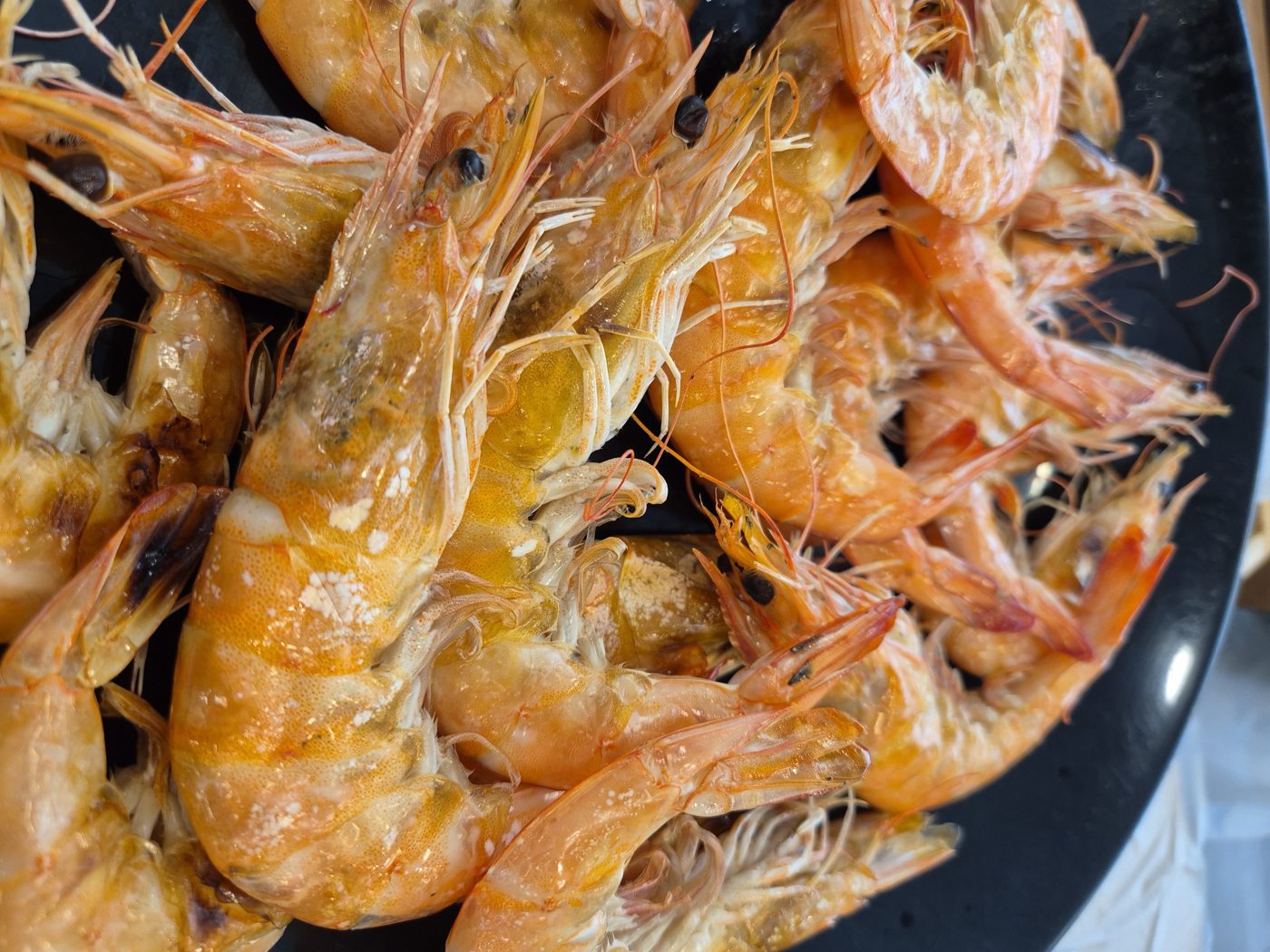
Salt-grilled prawns — they were whiteleg shrimp
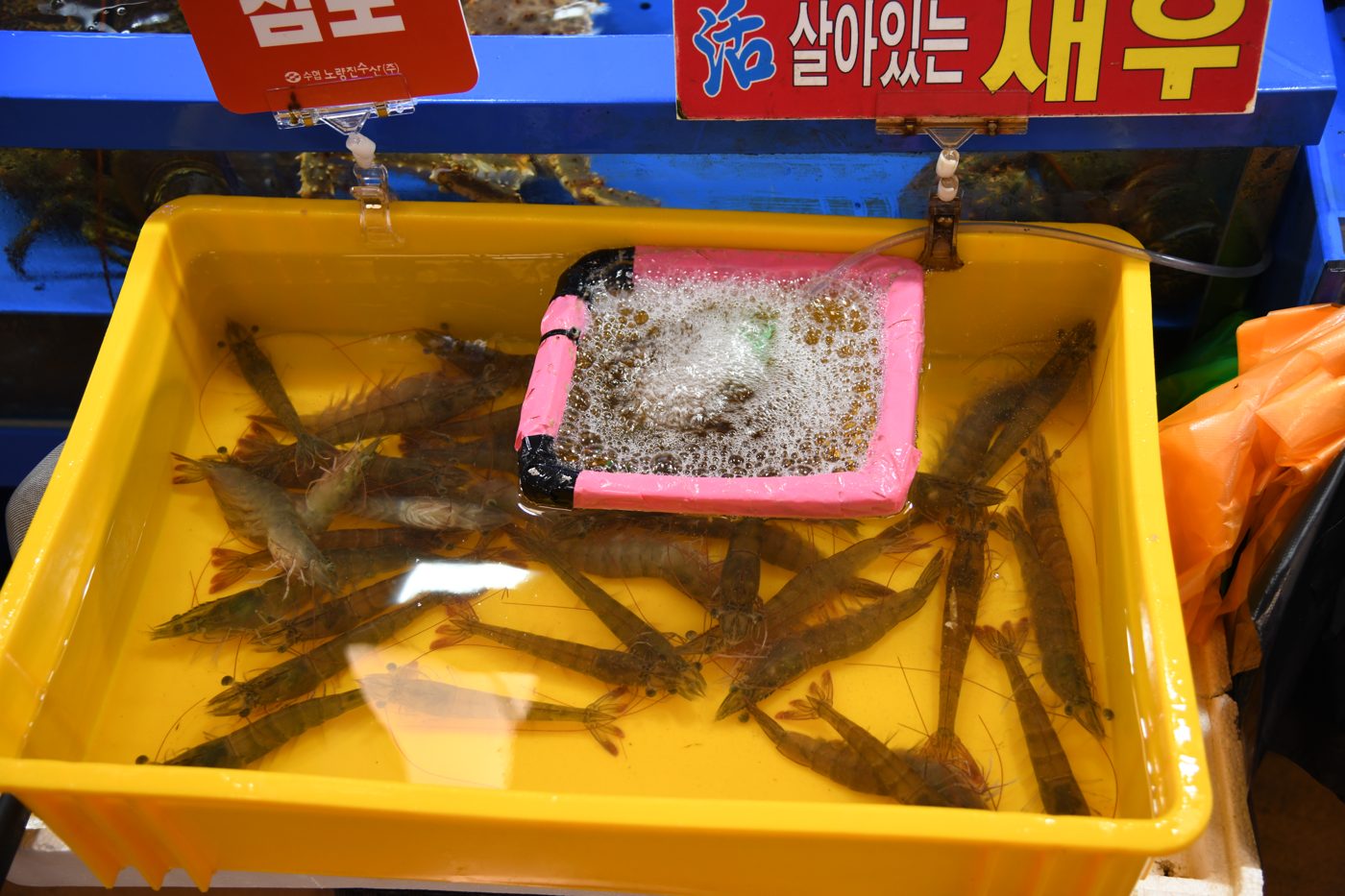
The other star of autumn at Noryangjin is shrimp. In front of the tanks hangs a sign reading 활 살아있는 새우, “live shrimp”, and the shrimp swim in a yellow tub. The pink oxygen pump in the middle is quite a sight.
The live shrimp in that yellow tub were ₩35,000 for about twenty. They are too good to grill. Eat them raw, while they are alive.
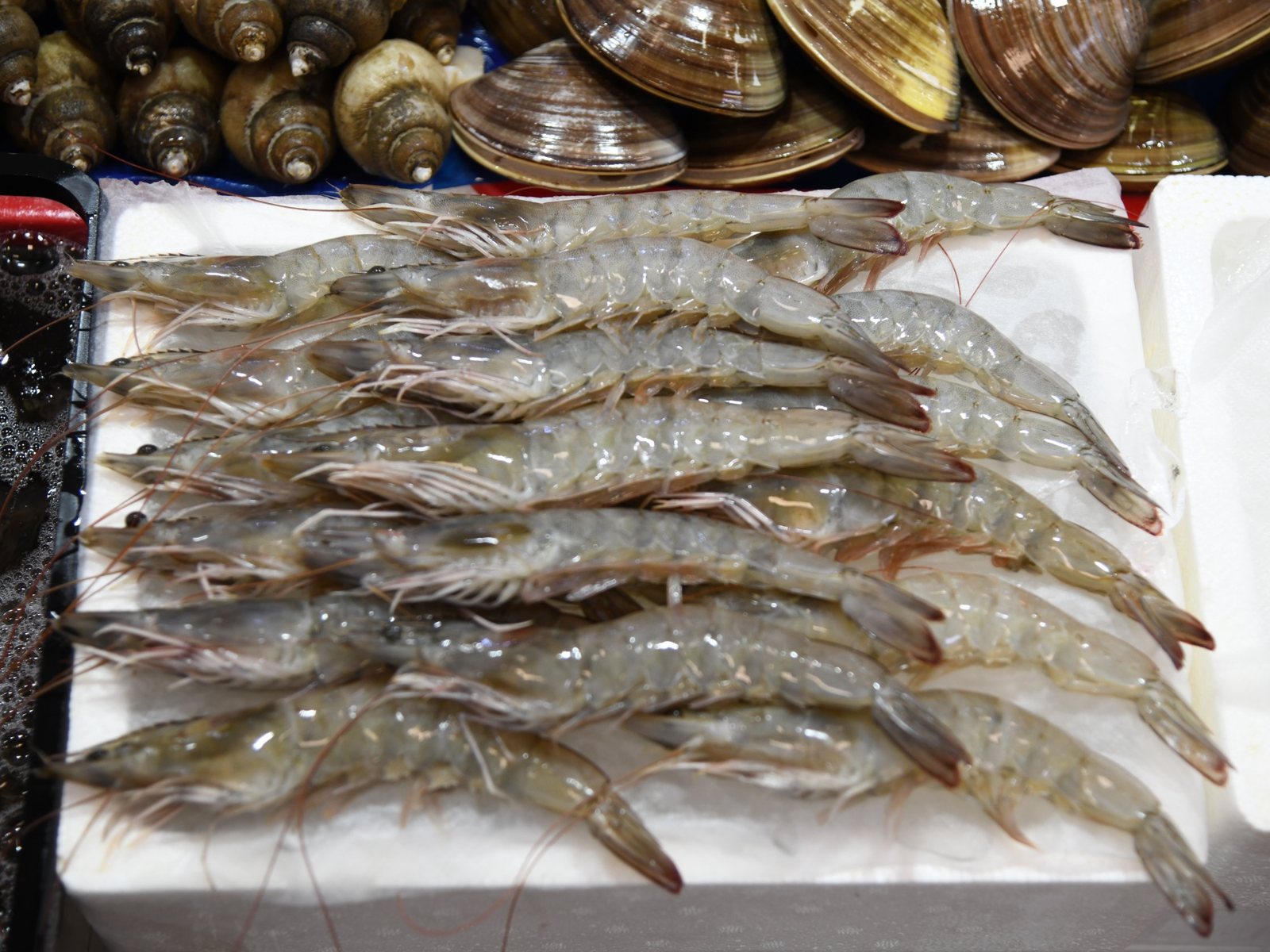
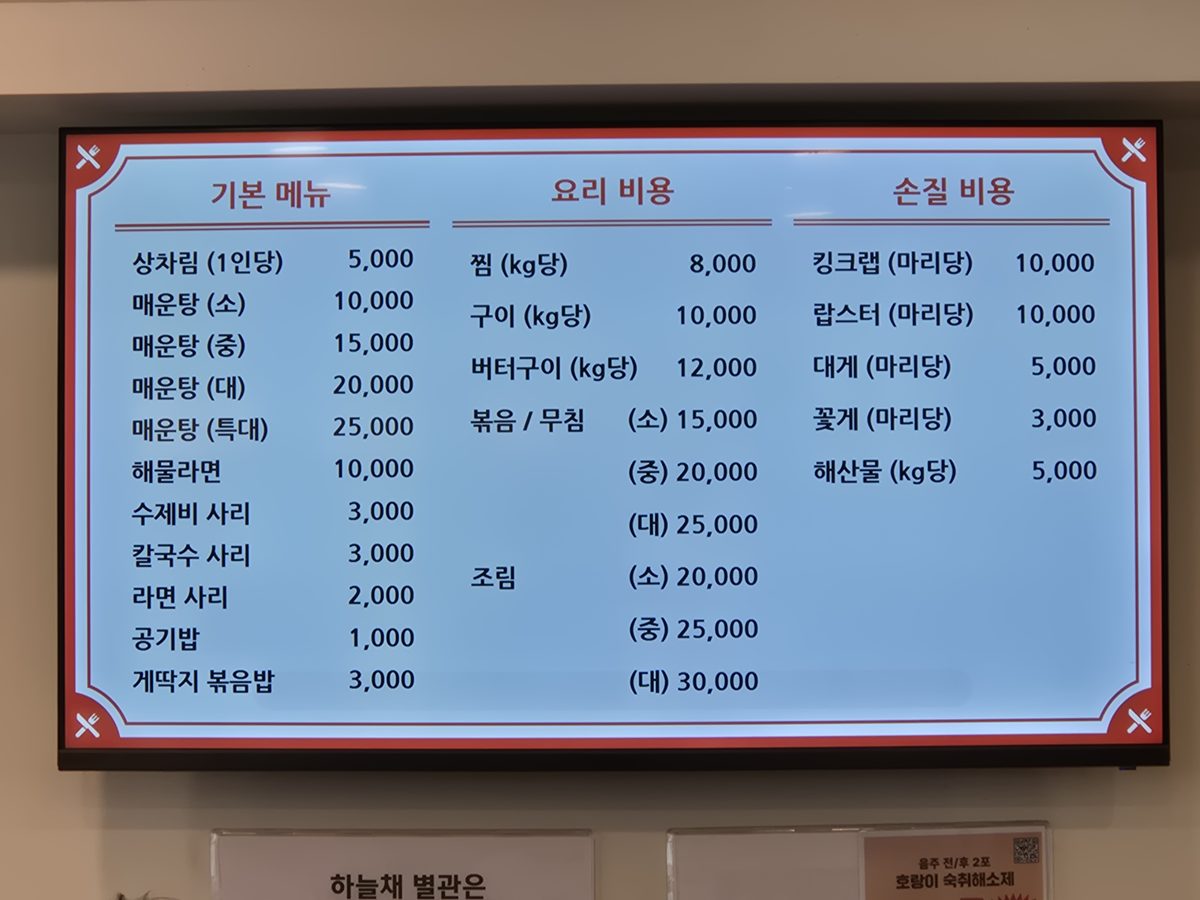
What we had as 소금구이sogeum-gui, grilled on salt, was imported 흰다리새우 — whiteleg shrimp — bought separately, ₩25,000 worth. Grilled shell-on over coarse salt, the head is the tastiest part. Peel and eat the body, then suck the head clean, guts and all: that is the Korean way. The restaurants inside the market grill them for ₩10,000 per kilogram; butter-grilled is ₩12,000, as on the price list below.
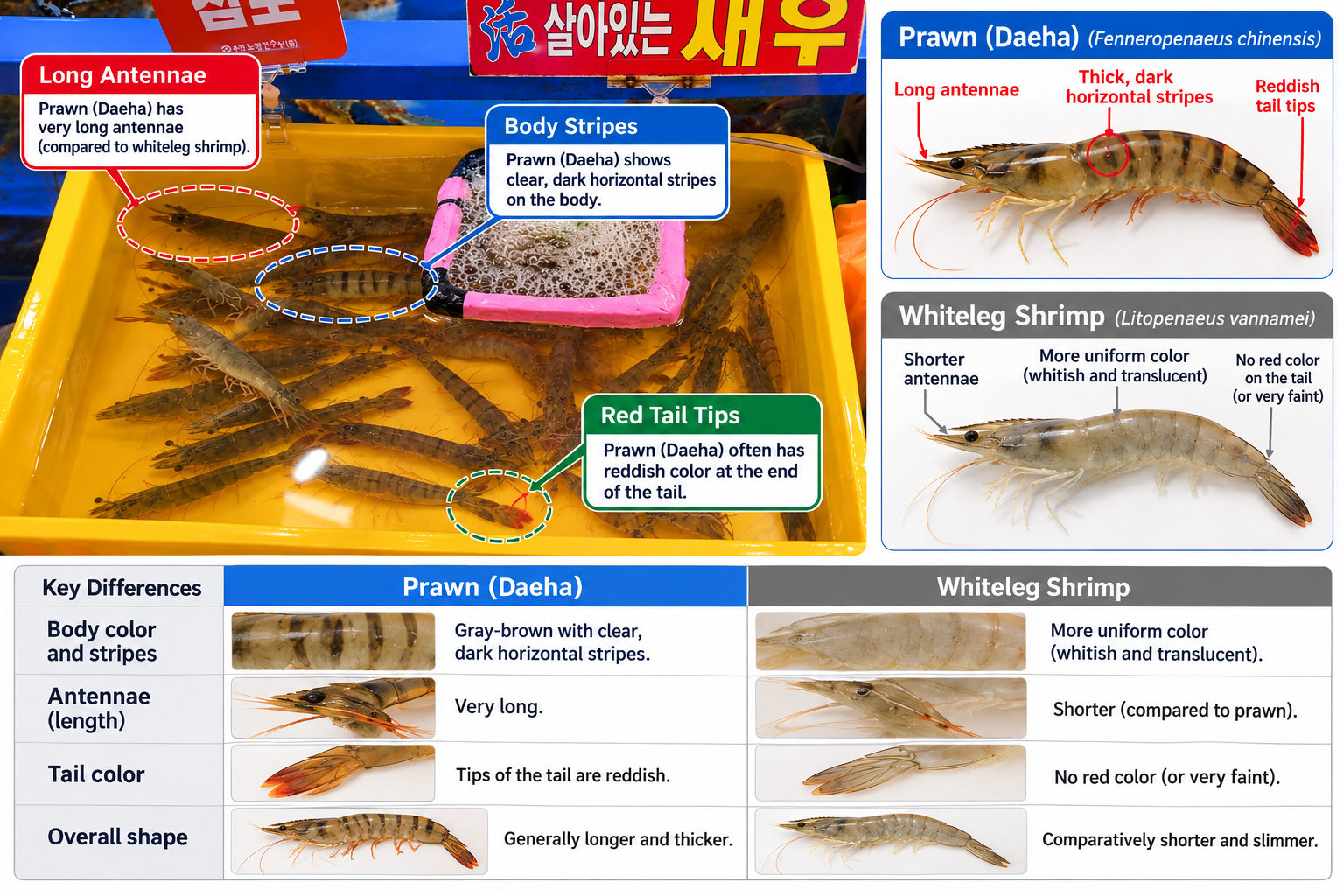
Whiteleg shrimp is not 대하daeha, the fleshy prawn of the west coast in autumn. If daeha is what you want, ask the seller clearly whether it is daeha and where it was caught. Shrimp has no price on the menu board, so ask.
The yellow tub under the ‘live shrimp’ sign. About twenty for ₩35,000 — shrimp to eat alive rather than grill.
Telling daeha from whiteleg shrimp: antenna length, body stripes, tail colour and overall shape. The illustration is in Korean; tap it to see it large.
Before grilling: the whiteleg shrimp we bought (imported). ₩25,000 worth for three; for two, ₩15,000 worth is plenty.
After grilling: the whiteleg shrimp, salt-grilled. Shells turn orange and the heads are full of yellow roe and guts.
04 · How it works
Buy it, then eat it at a table
This is how Noryangjin works: you choose your fish at the tanks, carry it to a restaurant inside the market, pay a table-setting fee and eat. Table fees and cooking charges differ from restaurant to restaurant, so check before you sit down.
Chojang-jip 초장집
초장chojang is a sweet-and-sour red dipping sauce of gochujang mixed with vinegar and sugar — the sauce you dip raw fish in. A chojang-jip is literally “a place that serves chojang”. In practice it is a restaurant where you bring the sashimi you bought in the market; it gives you a seat and the table setting — chojang, soy sauce, vegetables — and charges a seat fee (상차림비, sangcharim-bi). It does not sell fish. It is also where they boil the leftover bones into spicy stew and grill the shrimp or clams you bought. At Noryangjin Fish Market, the sashimi restaurants on 2F and 5F are the chojang-jip.
We went to the chojang-jip on 5F. There was only one, so there was nothing to choose. Not especially friendly, but that’s fine. The fish is what matters.
The price list at the restaurant I went to
Item
Won
Table settingper person
5,000
Spicy fish stew (maeuntang)S · M · L · XL
10,000 – 25,000
Grillingper kg · butter-grilled 12,000
10,000
Steamingper kg
8,000
King crab · lobster prepeach
10,000
Snow crab prepeach
5,000
Copied off the price list on site, early October 2026. It differs by restaurant and season.
The price list, in three columns: table setting, cooking and preparation. Prices change with the season and the restaurant, so trust the board on site.
05 · The full table
From the tank to the table, start to finish
Here, in order, is everything a first-time visitor to Noryangjin goes through to sit down to a sashimi meal. Prices are from the day the three of us ate, in early October 2026.
Before you go — On the Tpirates website (tpirates.com) or app, look at today’s prices and the partner shops’ fixed-price sets. Once you find a price you like, take a screenshot of the shop’s name, floor and stall number. You don’t need any Korean.
Arrive — About 70 m from exit 7 of Noryangjin Station on Line 9, about 150 m from exit 9 on Line 1. The ground floor (1F) is where live fish, shellfish and fresh fish are sold.
Choose — Follow the floor and stall number in your screenshot to that shop. Every shop stocks very different fish, so find the right one. Point at a platter on the menu board. Small (소) serves two. The three of us shared one small shad platter (₩70,000). Check the country-of-origin label and confirm the price again. Asking a price does not mean you have to buy.
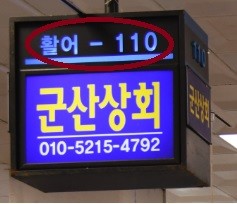
The stall number on top of the sign
Slicing and paying — The stall slices the fish for you on the spot. You pay for the fish here. Ask them to pack the head and bones left after slicing (서더리, seodeori) for the stew. Wasabi, rakkyo and radish sprouts go in the bag for free. If you want grilled shrimp, buy it here too. Shrimp has no price on the menu board, so ask. The three of us bought ₩25,000 worth of whiteleg shrimp; for two, ₩15,000 worth is plenty. If you want daeha, make sure it really is daeha.
To the chojang-jip — Carry your bag of sashimi up to a chojang-jip (sashimi restaurant) on 2F or 5F. You can also ask the shop where you bought the fish to recommend one. On 5F, where we went, there was only one, so there was nothing to choose.
The table — Sit down and pay the table-setting fee per person (₩5,000 each). Chojang, soy sauce, ssamjang, lettuce, garlic, chillies and kimchi arrive. Ask whether they have perilla leaves: with oily fish like shad or jack, perilla suits better than lettuce. Hand over the seodeori and they make spicy stew; hand over the shrimp and they salt-grill it (₩10,000 per kg). Our stew was a small (₩10,000). Order drinks at the chojang-jip. Makgeolli is usually ₩4,000–5,000 a bottle, though it varies wildly by brand.
The order of eating — Sashimi while it is cold, grilled food while it is hot. Eat the sashimi first, and tell them to bring the grill and the stew later.
Paying — You already paid for the fish at the 1F stall; the table setting, stew, grilling and drinks are paid separately at the chojang-jip.
What we paid · three people (won)
Item
Paid at
Won
Shad platter, smalla for-two menu · one for the three of us
1F stall
70,000
Whiteleg shrimp (imported)ask the price
1F stall
25,000for two, 15,000 worth
Table setting5,000 × 3 people
Chojang-jip
15,000
Spicy fish stew, smallmade from our seodeori
Chojang-jip
10,000
Salt-grilling the shrimpby the shrimp’s weight
Chojang-jip
10,000/kg
Makgeollia bottle · varies wildly by brand
Chojang-jip
4,000 – 5,000
Totalwithout grilling and makgeolli · about 40,000 each
120,000
From the day we ate, early October 2026. Grilling and makgeolli depend on how much you have, so they are left out of the total. It differs by restaurant and season.
06 · Maeuntang
Spicy fish stew
When the sashimi and the grill are done, the 매운탕maeuntang arrives. Boiled hot and spicy with bean sprouts and spring onion, the broth clears away the oiliness of everything that came before.
Leave the seodeori (head and bones) you brought from the fish stall with the chojang-jip and they boil it for you. Sizes run small, medium, large and extra large, from ₩10,000. Ours was a small (₩10,000).
Maeuntang on the boil: bean sprouts, spring onion and fish simmering in a fiery broth. If there is sashimi left over and you can’t eat another slice, it feels like a waste, but put it in the stew.
07 · Drinks
Sashimi calls for soju
We drank makgeolli. That was the friend who came with us insisting, though; in my view, sashimi calls for soju.
Mixing makgeolli with cider (Korean lemon-lime soda): pour both into a bowl and stir.
We didn’t drink the makgeolli straight from the bottle; we mixed it with 사이다saida, Korean lemon-lime soda. Pour soda and makgeolli into a bowl in turns. The fizz lightens makgeolli’s heaviness. Makgeolli is usually ₩4,000–5,000 a bottle, though it varies wildly by brand.
이모! 소주 한 개요~ — give it a shout: “Imo! One soju, please!” 🙋
Imo means “auntie”; it is how Koreans call the staff at a casual restaurant.
08 · Korean cards
Show these to the seller
It’s fine if you can’t make yourself understood. Tap a phrase and it fills the screen. Just show it.
Tap to close · 화면을 누르면 닫혀요
09 · Afterwards
Across the river, a stop or two
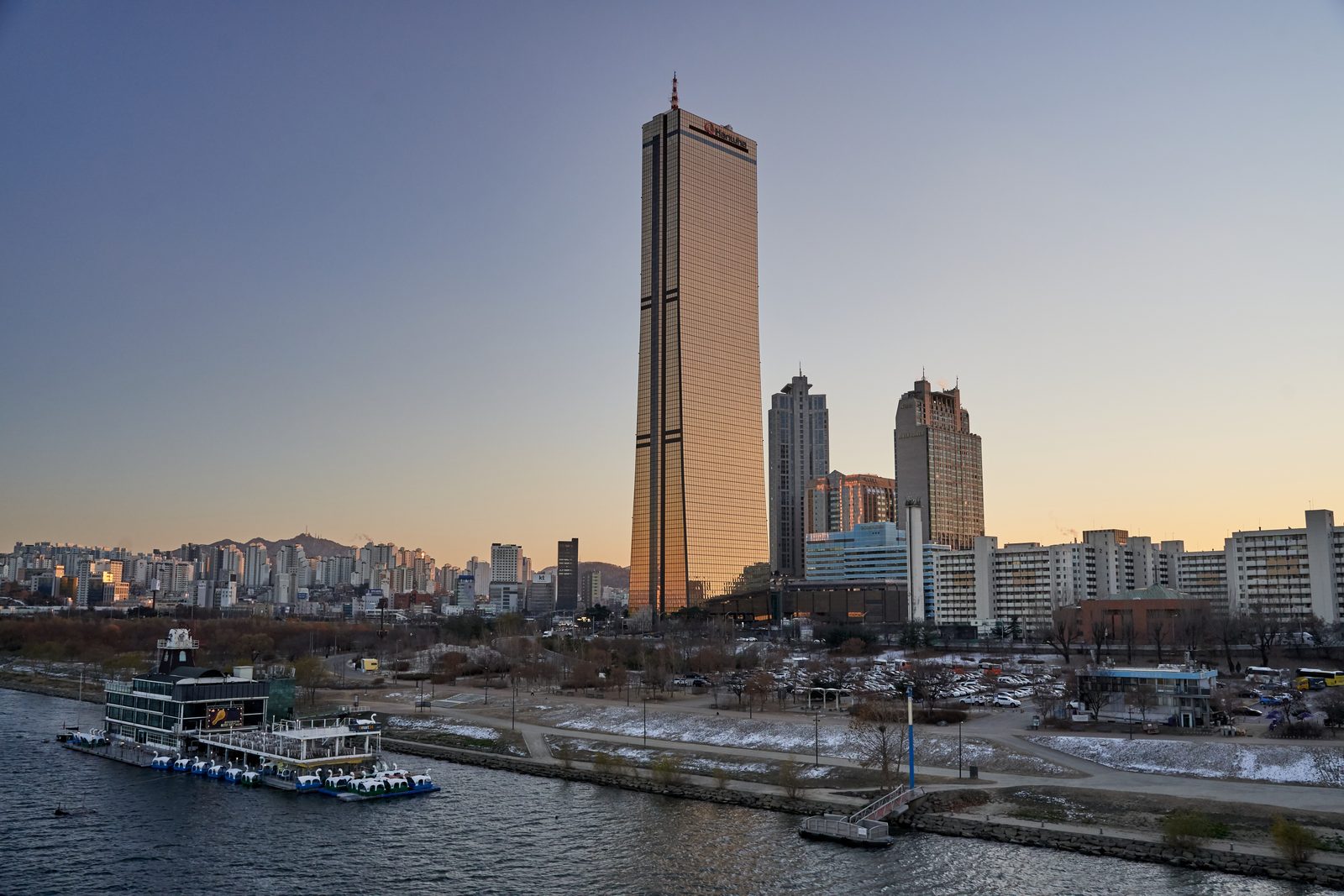
Noryangjin sits right on the south bank of the Han River. Look north from the road in front of the market and the 63 Building stands there; to the east, Hangang Bridge crosses the river by way of Nodeul Island. They look close, but the walking routes are awkward, so we take the subway to all four — each is one or two stops from Noryangjin Station on Line 9. 🚇
From Noryangjin Fish Market
63 Building63빌딩63 Sky Picnic, 60th-floor observatoryLine 9, 1 stop Saetgang Stn 0.5 km directRaise your head at the market and a golden glass tower fills the northern sky. Opened in 1985, it is the landmark of Yeouido, and in June 2026 its 60th-floor observatory reopened as 63 Sky Picnic. Even so, this tower is as good to look at from outside as it is to go up. Seen from across the river at sunset, the whole glass face turns the colour of the evening.Getting thereLine 9 from Noryangjin to Saetgang (1 stop), leave by exit 1 and walk towards the 63 Building. It is also close to exit 4 of Yeouinaru Station on Line 5.The 63 Building at a winter sunset. The riverbank below is Yeouido Hangang Park.Google directionsNaver directions
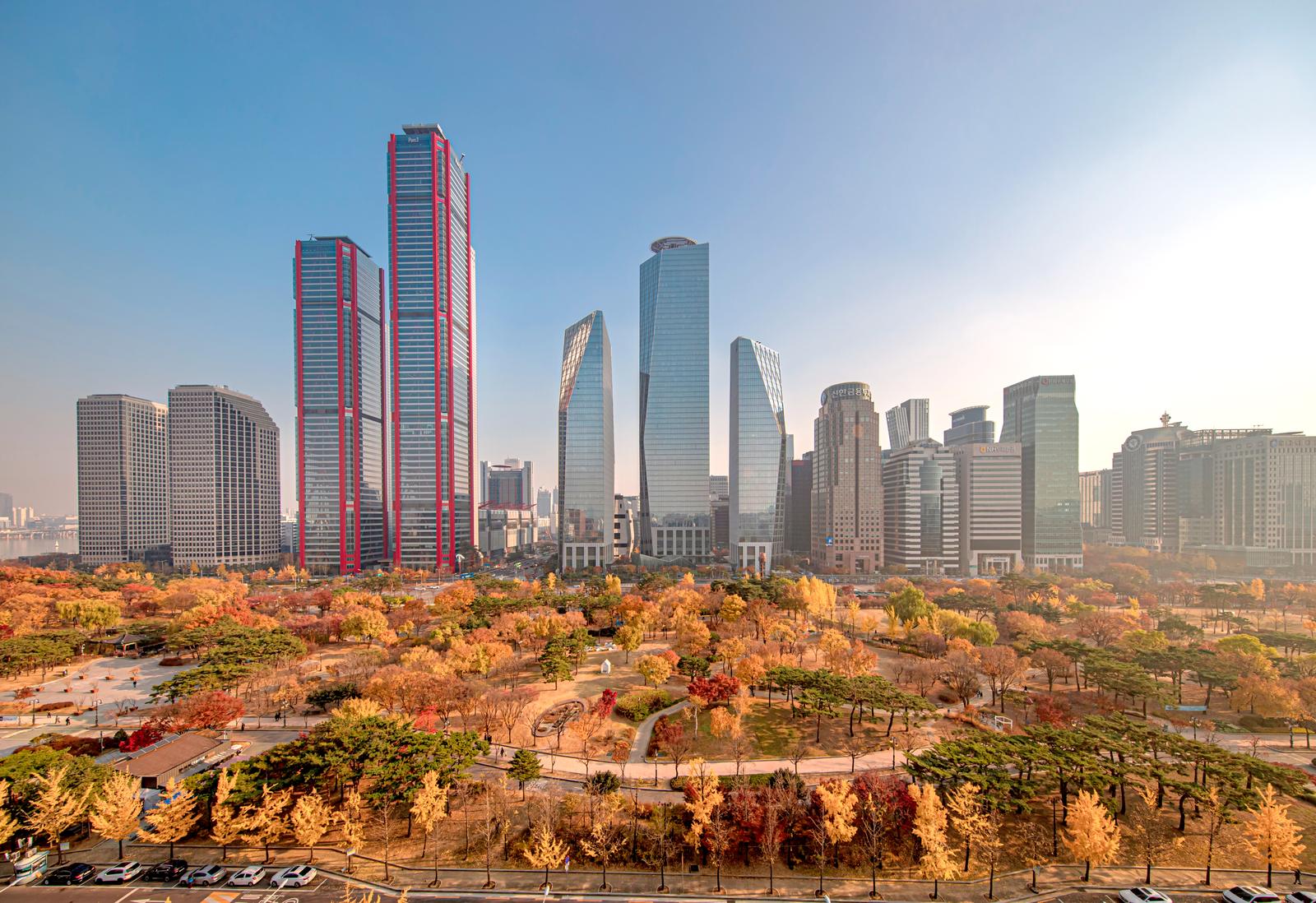
Yeouido Hangang Park여의도 한강공원Riverside open 24 hoursLines 9 & 5 Yeouinaru Stn 1.6 km directA park that runs a long way along the north shore of Yeouido. Spread a mat and sit watching the river, or rent a bike and ride along it. On the way you pass Yeouido Park, where in autumn the ginkgo and maple trees turn yellow and red between the towers.Getting thereLine 9 from Noryangjin to Yeouido (2 stops), change to Line 5 for Yeouinaru (1 stop). The riverbank is right outside. You can also walk from Yeouido Station through Yeouido Park.Yeouido Park in autumn, on the way from Yeouido Station to the river park.Google directionsNaver directions
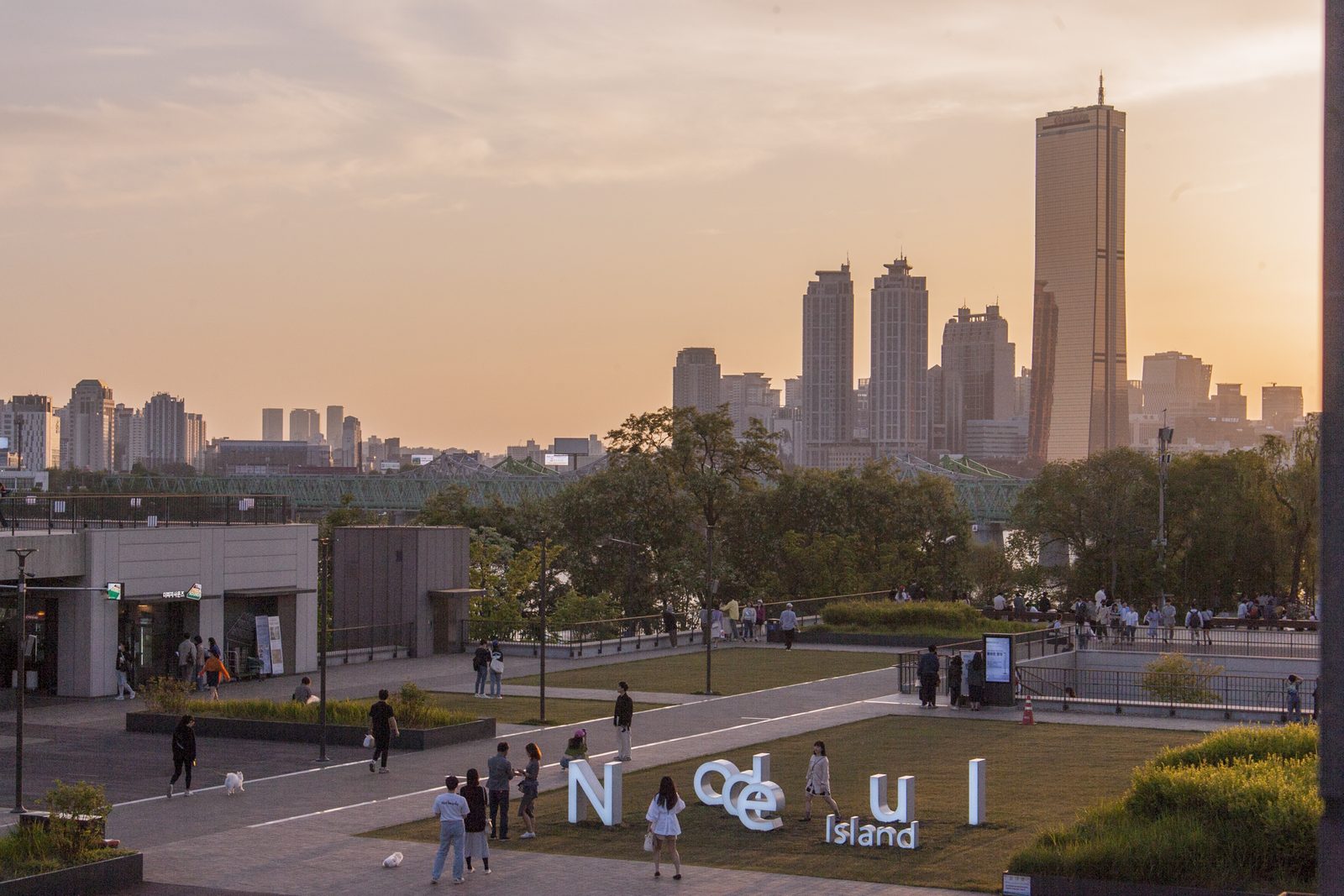
Nodeul Island노들섬Outdoor areas 24 hoursIndoor venues closed MondaysLine 9, 1 stop Nodeul Stn 1.7 km directAn island hung in the middle of Hangang Bridge, with a lawn, a concert hall, a bookshop and cafés. Stand at its western tip and the 63 Building and Yeouido line up beyond the Hangang Railway Bridge. It is busiest at sunset, and it is the nearest place to catch the river breeze after sashimi and makgeolli.Getting thereLine 9 from Noryangjin to Nodeul (1 stop), leave by exit 2 and walk about 700 m towards Hangang Bridge. By bus, get off at the Nodeul Island stop.
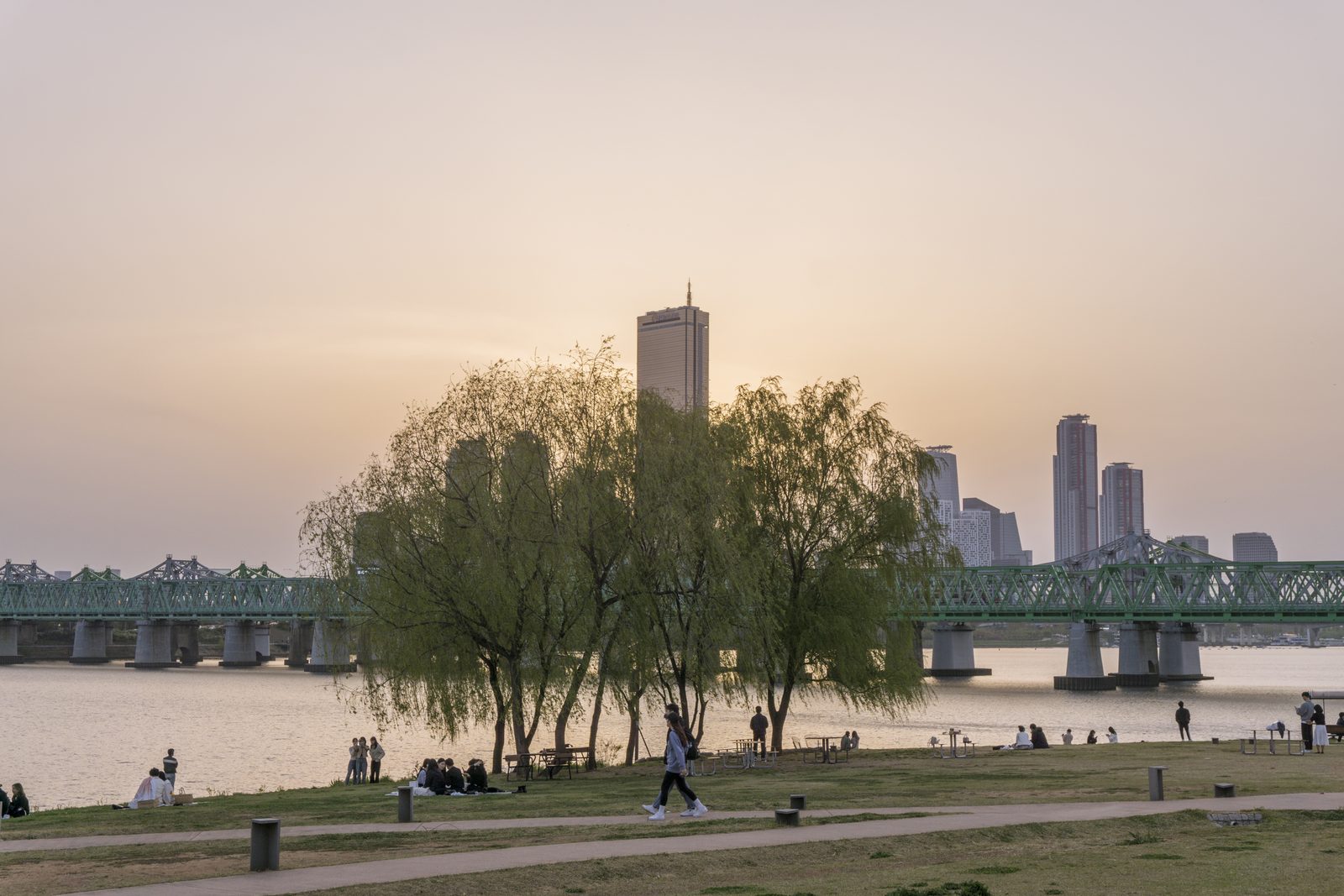
The plaza on Nodeul Island. In the evening the sun sets towards the 63 Building.The 63 Building beyond the Hangang Railway Bridge, seen from Nodeul Island. Anywhere along the river around Noryangjin, you can see this building.
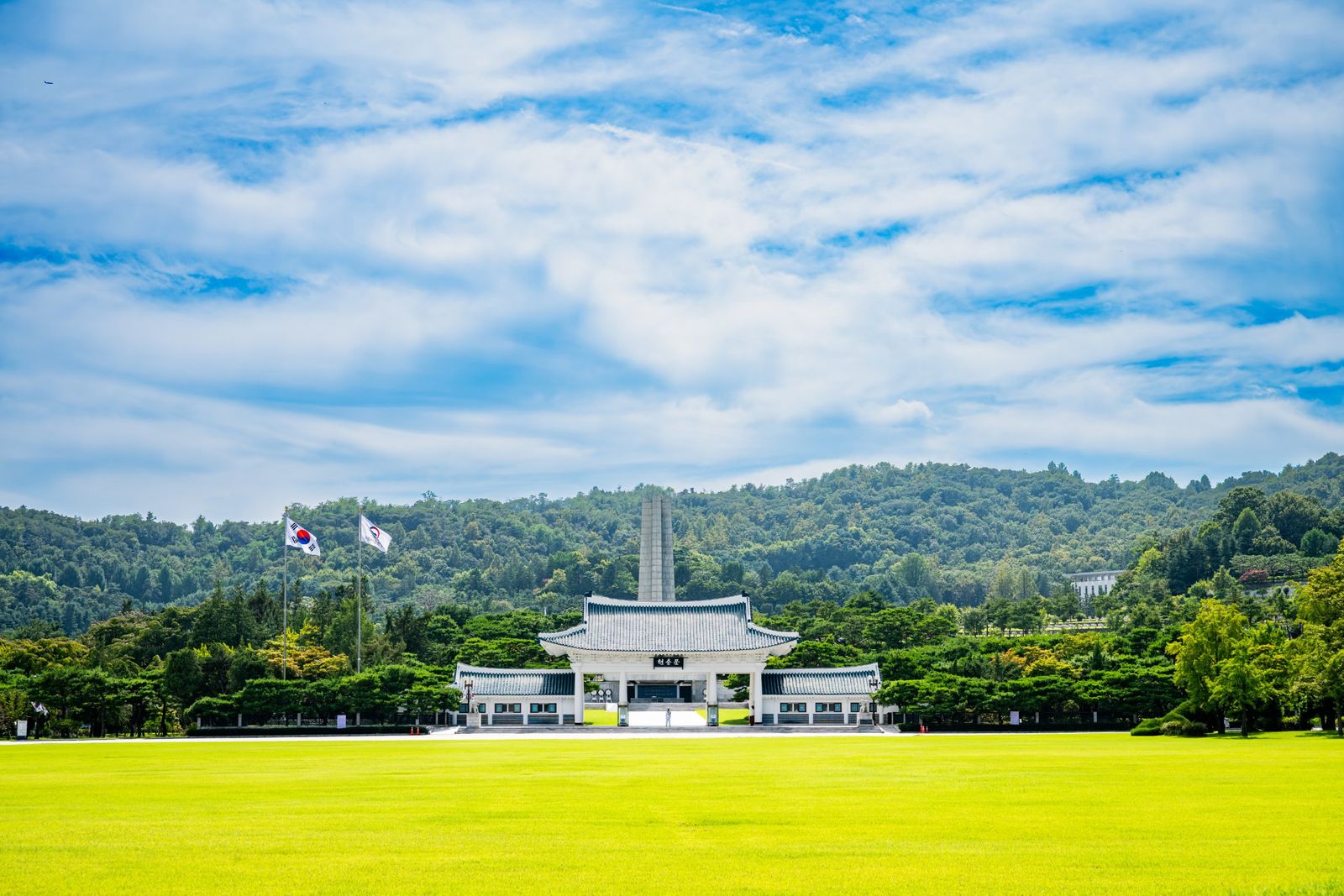
Seoul National Cemetery국립서울현충원06:00–18:00Open every dayLine 9 express, 1 stop Dongjak Stn 3.3 km directThe national cemetery where those who gave their lives for the country lie. The graves spread through a wide forest under a spur of Gwanaksan, so it is a good place for a quiet walk. In spring it is known for its weeping cherry trees. It is a place of remembrance, so mind your clothes and your voice.Getting thereLine 9 express from Noryangjin to Dongjak (1 stop), exit 8. From Dongjak Station on Line 4, use exit 2 or 4.Seoul National Cemetery.Google directionsNaver directions

 Sea breamspringJacksummerSea basssummerShadautumnFlounderautumn–winterSalmonall year