
Rows of Korean onggi jars on a traditional jangdokdae terrace, where soy sauce and doenjang ferment in the open air
← Gastronomy

The Story Behind the DishNothing on the table
is an accident

On the longest night of the year Koreans cook red bean porridge — not for the warmth, but for the colour. Red turns away whatever walks in the dark. Korea has been serious about food for a very long time, long enough that a meal here is rarely only a meal.

Scroll Down

Jangdokdae장독대 The jar terrace: soy sauce and doenjang ripen here in the open air, lids lifted to the sun on fine mornings and closed again before the rain.

Why Koreans eat this way

Every dish here is made with jeongseong — the care nobody sees.

There is a Korean word that survives translation badly: jeongseong (정성). It means the care poured into something, measured not by how the dish turns out but by the hours nobody will ever see. Cabbages salted before dawn for kimjang. Jar lids on the terrace opened to the sun every fine morning, for years. A memorial table that takes two days to prepare for a meal no living person eats.

To say food was made jeongseong-kkeot (정성껏), with all the care one has, is the highest praise a Korean home cook can hear. It is also why nothing on the table is there by accident: not the colour of a porridge, not the direction a fish faces, not the number of dishes. When you eat in Korea, taste the time as well as the food. Understand this one word, and Korean food explains itself better than any recipe can.

Jisup Shin

The story behind the dish

Four threads behind Korean food

The calendar, the ancestors, the jar and the long history of borrowing. Follow these four and most of the Korean table starts to make sense.

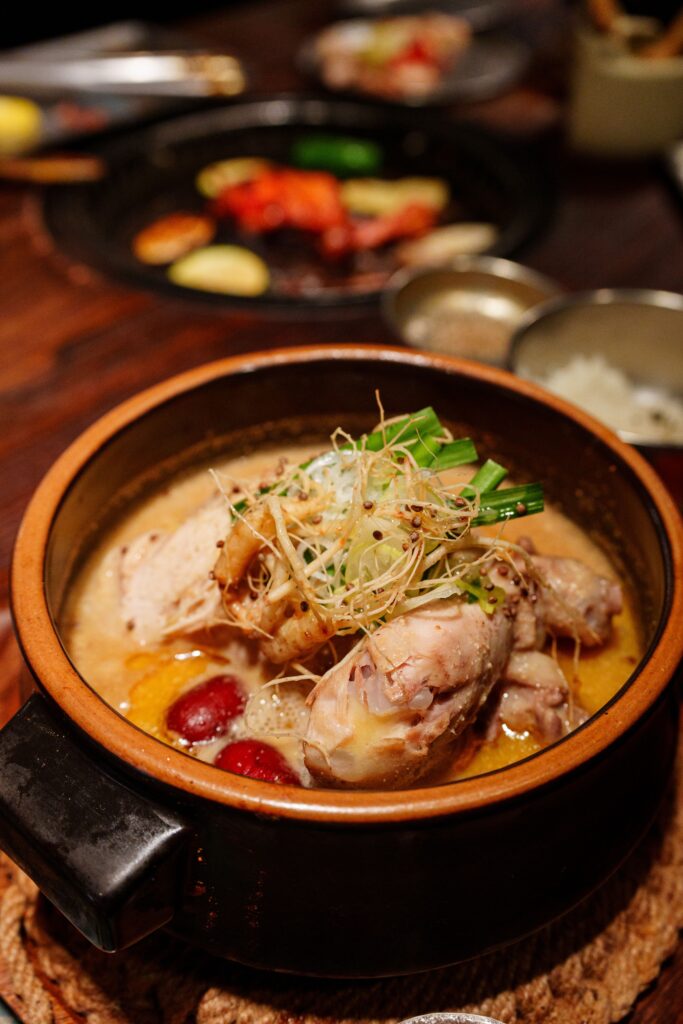
Korean samgyetang, a whole young chicken stuffed with rice and ginseng, simmering in an earthenware pot

Jeolgi · the seasons

The Calendar You Eat

절기 · jeolgi

The year was read at the table long before anyone read it on paper. A bowl of Tteokguk on New Year’s morning adds a year to your age — Koreans do not turn a year older, they eat a year older. On the longest night of winter, red Patjuk keeps the dark out, and at the first full moon we crack a walnut at dawn — Bureom — to keep the year’s boils off the skin.

Songpyeon at Chuseok, Samgyetang on the three hottest days of summer: every turn of the calendar arrives as something to cook.

  • Tteokguk
  • Patjuk
  • Bureom
  • Songpyeon
  • Samgyetang
Dried Korean jujubes in a white bowl on a wooden board, the fruit laid on ancestral memorial tables

Jesa · the ancestors

A Table for the Dead

제사 · jesa

The memorial table has a grammar: red fruit east, white fruit west, fish on one side and meat on the other. No garlic, no chilli — strong smells were thought to drive a visiting spirit away. Jujubes are said to stand for descendants, chestnuts for the seed that stays with its root underground.

Two days of work for a meal no living person eats. That is what we mean by jeongseong.

  • Daechu
  • Bam
  • Jeon
  • Tang
  • Sikhye
Meju, blocks of fermented soybean bound in rice straw and hung to dry under the eaves of a Korean farmhouse

Balhyo · fermentation

Food That Waits

발효 · balhyo

Korea’s oldest cooking technique is patience. It starts with Meju — soybeans steamed, pounded into bricks, tied in rice straw and hung under the eaves all winter, where whatever lives in the straw and the air moves in. Months later the blocks go into brine and separate into soy sauce and Doenjang.

A family’s Ssi-ganjang — seed soy sauce — is topped up rather than replaced, sometimes for generations: it is inherited, not made. The jar terrace was a laboratory long before anyone had the word for fermentation.

  • Meju
  • Doenjang
  • Ganjang
  • Gochujang
  • Kimchi
A steel bowl of gochugaru chilli seasoning mixed with spring onion and radish for kimjang, Korea’s winter kimchi-making

Jeollae · history

Later Than You Think

전래 · jeollae

Some of the most Korean things on the table are recent arrivals. Chilli only reached the peninsula around four hundred years ago, so Kimchi has been red for a small fraction of its life. Seolleongtang is popularly traced to a royal ploughing rite; Budae-jjigae to army-base surplus after the war.

Tradition here is not a sealed room. It is a long conversation still going on.

  • Kimchi
  • Kimjang
  • Seolleongtang
  • Budae-jjigae

FAQ

Korean food traditions: FAQ

What does jeongseong mean in Korean food?

Jeongseong (정성) is the care poured into something, measured not by the result but by the hours nobody sees. It is the word Koreans use for the effort behind a memorial table, a day of kimjang or a jar of soy sauce kept for generations, and to cook something jeongseong-kkeot (정성껏), with all the care you have, is the highest praise a home cook can receive.

Why do Koreans eat red bean porridge on the winter solstice?

Patjuk (팥죽) is eaten on Dongji, the longest night of the year, for its colour rather than its warmth. Red was believed to turn away misfortune, so a ladle of the porridge was once splashed at the gate and the soy jar terrace. Rice balls are added to the bowl, traditionally one for each year of your age.

What is bureom?

Bureom (부럼) is the custom of cracking hard nuts such as walnuts, chestnuts or peanuts between your teeth at dawn on the first full moon of the lunar year. One clean snap was said to keep boils and skin ailments away for the whole year.

Why is there no garlic or chilli in Korean ancestral rite food?

Food for a jesa, the ancestral memorial rite, is cooked without chilli powder, garlic or strong seasoning because pungent smells were believed to drive a visiting spirit away. The dishes are pale, mild and arranged in a fixed order on the table.

Why do Koreans eat seaweed soup on their birthday?

Miyeokguk (미역국) is served to a woman after childbirth, so eating it on your birthday is a way of remembering the day your mother ate it for you. Almost every Korean eats a bowl once a year for their entire life.

What is meju, and why is it hung in straw?

Meju (메주) is a block of steamed soybeans pounded together and tied in rice straw, then hung under the eaves through winter. Wild moulds and bacteria carried in the straw and the air settle into the block, and the finished meju is later dropped into brine to become soy sauce and doenjang.

When is kimjang, and what is it?

Kimjang (김장) is the communal making of winter kimchi, usually in late November or early December once the cabbages are in. Families and neighbours salt, wash and dress hundreds of cabbage heads in a single day. UNESCO listed the practice as intangible cultural heritage in 2013.

Journal

Rituals, beliefs, old habits and jeongseong

Photographs of Korean ritual food and fermentation © Korea Tourism Organization (한국관광공사). Used with permission.

Scroll to Top