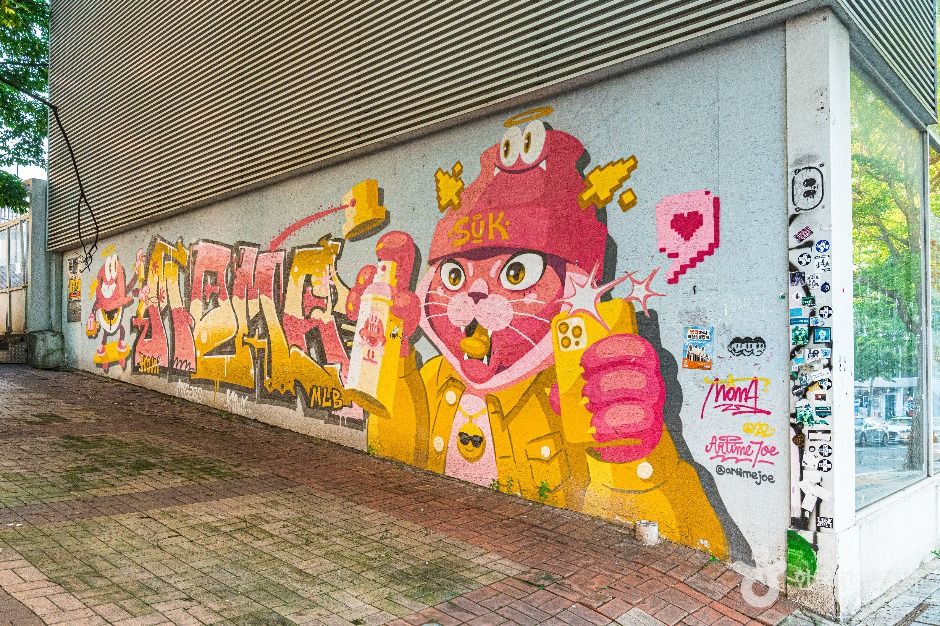

A long painted wall in Hongdae covered in pink and yellow graffiti, including a cat in a beanie holding a phone, running beside an empty paved street
Design Your Travel Korea
← Culture

Media · Screen & StageYou came for the show.
Here is where it happened.

Koreans call these places 성지 — sacred ground. It is said with a wink, but the pilgrimage is real. Two to begin with: one you follow across the city, one you simply turn up to.

Scroll Down

Hongdae홍대 The painted walls around Hongik University, where street musicians have played to passers-by for decades.

A note before the show

I went to high school where Winter Sonata was filmed.

Jungang High School sits at the far end of an alley in Gyedong. In the winter of 2001, my second year there, Bae Yong-joon, Choi Ji-woo, Park Sol-mi and the late Park Yong-ha came to the school to shoot the drama. None of us imagined it would become part of K-culture legend. For a long time afterwards, walking out after class, I would pass women from Japan standing at the gate, quietly looking in.

Growing up in Seoul, I kept running into actors by chance: on the Deoksugung stone wall road, around Daehangno, in subway stations. This page gathers places like those, from the scenes you know on screen to the streets where K-culture itself grew up, somewhere you can lose yourself in it for an afternoon.

The places on screen are real, most of them are free, and many look just as they did on the day they were filmed. Walk them slowly, keep your voice down where people live, and let the city show you the parts the camera left out.

Jisup Shin

Screen & stage

The Goblin route,
and the Hongdae street

The first is a drama you can walk through, stop by stop. The second is not about a scene at all — it is a place where the thing you came to see is still happening tonight, for free, whether or not anyone is filming.

Goblin · 2016

A drama you can walk through

Dokkaebi · 도깨비
Best for — a full day, mostly on foot, one bus ride out of the city

Almost none of this drama was built. The production shot in ordinary streets, a working harbour and a school that was taking lessons the week before. That is why it holds up as a route rather than a single photograph — you are not visiting a set, you are visiting a city that was borrowed for a while and then handed back.

The film above is the proof. For the tenth anniversary the four leads went back to the breakwater together: Gong Yoo and Kim Go-eun brought the red scarf and the buckwheat flowers and stood in the same spot, and Lee Dong-wook and Yoo In-na saw it for the first time. What Yoo In-na said when she got there — that it was uncannily unchanged — is the part that matters if you are the one travelling. The pier is a public structure. Nothing has been dressed for you, and nothing has been taken away.

  1. 01

    Jumunjin breakwater, Gangneung

    The candle goes out, she turns, and he is there. 2 hrs 20 by bus · the one stop outside Seoul
  2. Unhyeongung Yanggwan — the Goblin's house 02

    Unhyeongung Yanggwan — the Goblin's house

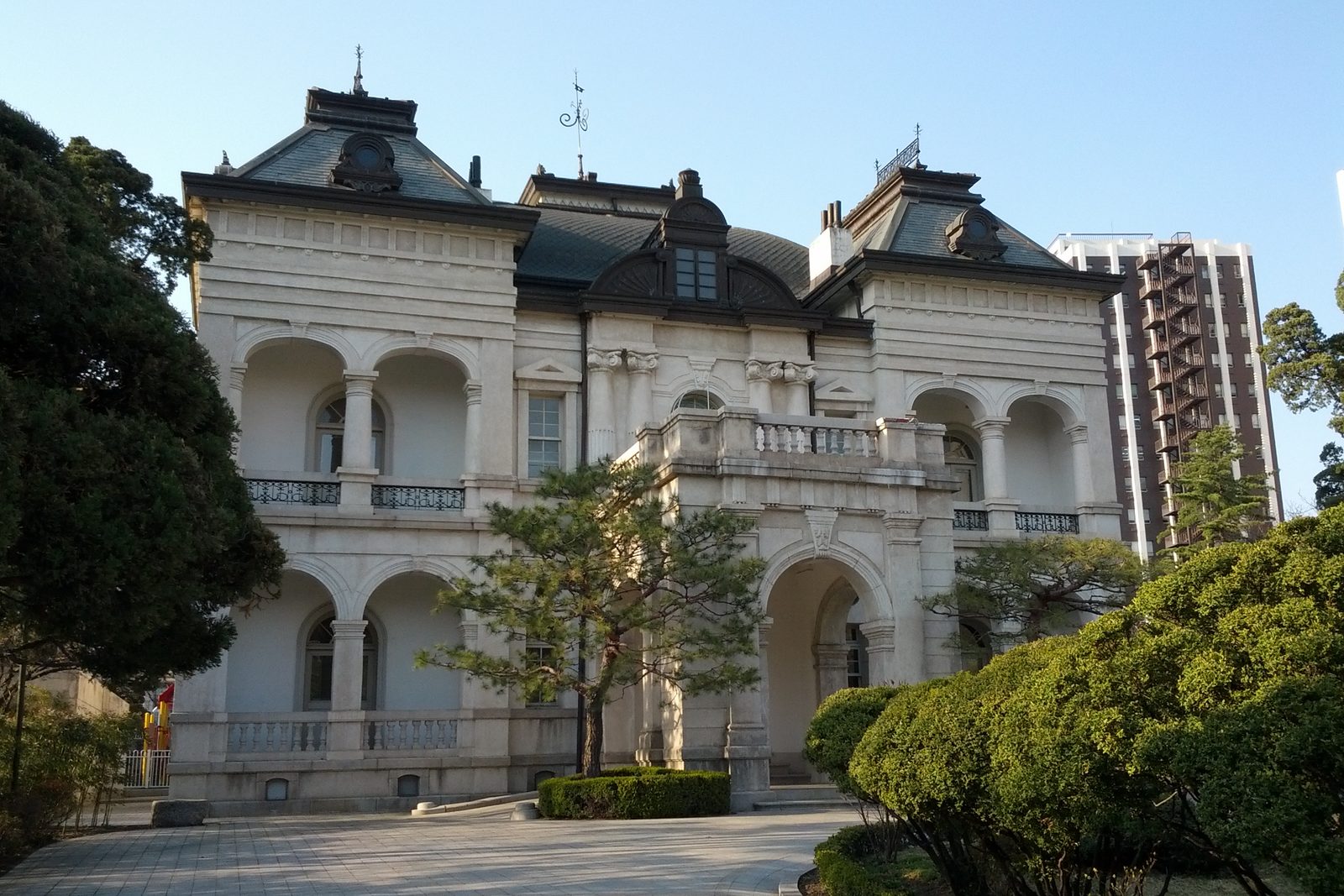
    Kim Shin's mansion, and the house he shared with the Grim Reaper. A French Renaissance villa built around 1912 — arcaded verandas, a mansard roof, plum blossom crests in the stonework — now standing on a university campus behind the palace. Anguk stn · exterior only, no interior access
  3. The Bukchon lanes around it 03

    The Bukchon lanes around it

    Where the walking-and-saying-nothing scenes live. Anguk stn · visitors 10:00–17:00 only
  4. Deoksugung stone wall road 04

    Deoksugung stone wall road

    The old superstition says couples who walk it break up. They filmed here anyway. City Hall stn · ten minutes' walk

The Yanggwan stands on a working university campus and the inside is not open. Photograph the facade from the drive and leave it there. Bukchon is a residential Red Zone: visits are allowed 10:00–17:00 and a fine applies outside those hours. People live behind those gates.

Stops4
CostFree
AllowOne day
Live · most evenings

Nobody asked who he was

Hongdae · 홍대
Best for — a Friday or Saturday evening, no ticket, no plan

In 2014 a television crew spent five hours putting one of Korea's most famous singers into old-age prosthetics and set him down on this pavement with a band. He sang. The crowd stopped, listened, applauded warmly — and went on with their evening. Nobody questioned it.

That reaction is the whole point, and it is why the stunt worked here and would have failed almost anywhere else. On this street, a stranger singing extraordinarily well is not a mystery to be solved. It is a Tuesday.

The pavement is only the free tier. Behind it are the rooms that have been booking the same kind of act for decades, and a ticket to one of them costs less than a concert seat by an order of magnitude.

“I have been coming to this street since 2005. It was already the place indie bands came to be heard — that part is not new, whatever the K-pop tours tell you. I still stop for people whose names I never learn.”

— Editor, Design Your Travel Korea

Things fill up from around seven and peak by nine. Weeknights are thin, and heavy rain clears the street completely. Cash in the case if you stayed for a whole song — that is the etiquette.

Nearest stopHongik Univ.
From19:00
CostFree
Journal — screen & stage

Trips out,
written up after

Whether the pier was worth four hours on a bus, which lane was empty at nine in the morning, and what we would do differently next time. Longer than a card, shorter than a guidebook.

Journal entries appear here as we publish them.

Scroll to Top