A CU convenience store in Seoul at night, its sign and windows lit
Design Your Travel Korea
← Accommodation

Near Your Stay in KoreaAround the corner,
open right now

Korean neighbourhoods keep the useful things unusually close together — a pharmacy, a walk-in clinic, a laundrette, a locker, and a convenience store that never closes, most of them within five minutes of the door. Here is what to look for, when it opens, and what it costs.A pharmacy, a walk-in clinic, a laundrette, a locker and a store that never closes, most within five minutes of your door in Korea.

Scroll Down

Open all night편의점 A CU in Seoul after dark. There is usually one below your building.

A letter on what’s outside the door

Some of the places you need most on a trip are the ones you walk straight past.

When I stayed in Shinjuku, I ate breakfast every morning at Yoshinoya, Matsuya or Sukiya, taking the three in turns. I love gyudon, and there I could work my way through every kind of it, so I grew very fond of those places. In Korea it is hard to find gyudon that cheap and that good.

In the same way, though, Korea has Gimbap Cheonguk (김밥천국) and Gobongmin Gimbap (고봉민김밥), so gimbap is never far away. I don’t think there are many places where gimbap is as easy to come by as it is here.

When you travel, there are shops you actually need, yet you never use them, or walk right past, simply because you don’t know what they are.

So the journal on this page is about what’s around where you stay: the everyday places near your door, and all the odds and ends that don’t fit anywhere else.

Jisup Shin

Within five minutes of the door

Six essentials near
your accommodation in Korea

Worth confirming on the map before you book — and worth knowing what each sign looks like before you go out at eleven at night looking for one.

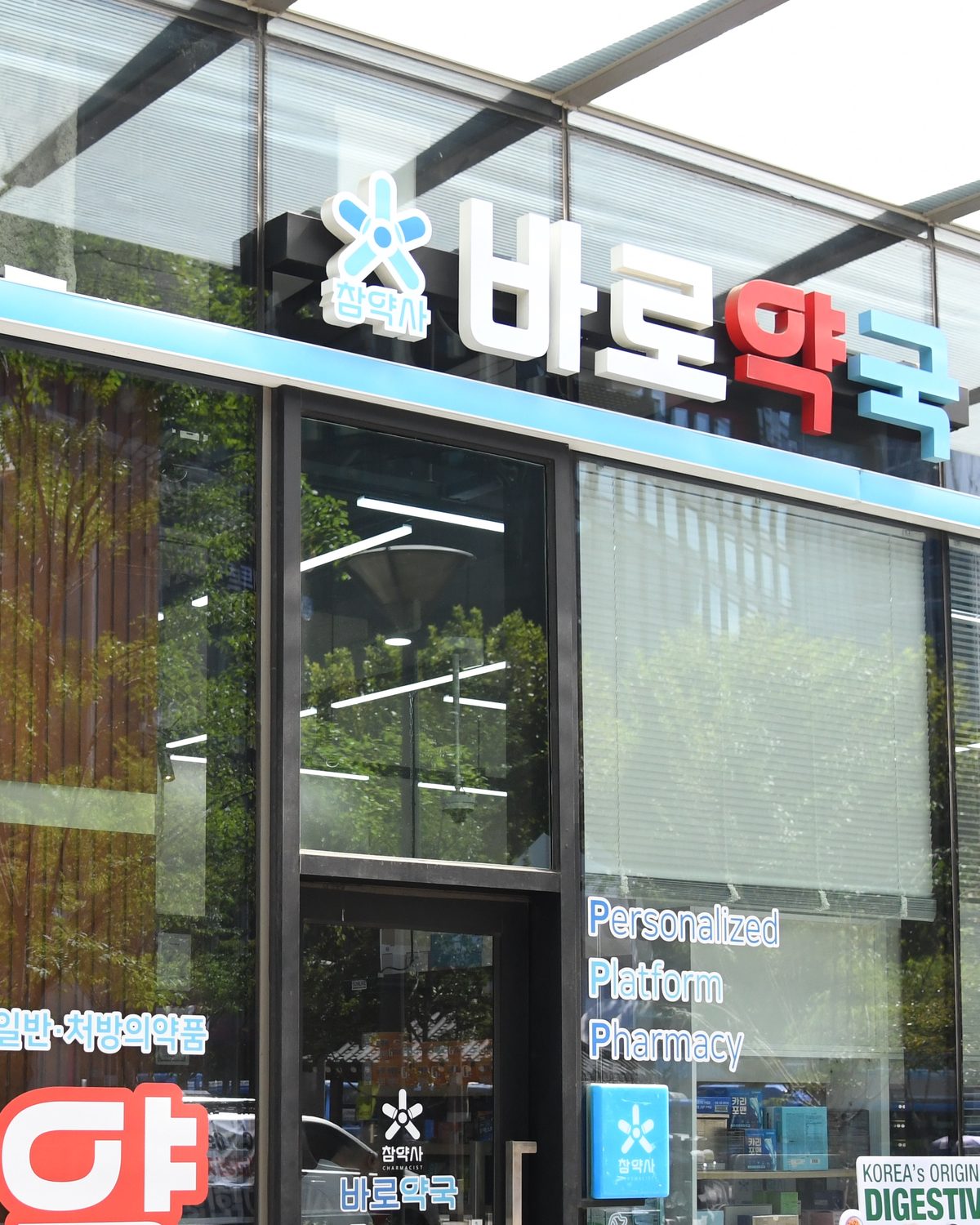
A Korean pharmacy storefront with the 약국 sign above the door and a large red 약 in the window

Pharmacy

약국 · Yakguk
Look for — a green cross, lit, above the door

Pharmacists in Korea hand over considerably more without a prescription than you may be used to: painkillers, cold medicine, stomach remedies, rehydration sachets. Most read English well even when they answer in short sentences. Show them where it hurts and they will usually get there.

Usual hours09:00–19:00
SundaysMostly closed
Beside a hospitalOpen late
Inside a Korean convenience store: an aisle of instant noodles and snacks, with a small eating area at the back

Convenience store

편의점 · Pyeonuijeom
Look for — CU, GS25, 7-Eleven, Emart24

Open all night, on nearly every block, and genuinely the answer to more problems than it should be: transport cards and top-ups, phone chargers, cash withdrawal, parcel drop-off, basic medicine, and a hot meal at two in the morning. Check there is one below your building before you book anything.

Hours24/7
Card paymentEverywhere
ATMMost branches
A 24-hour self-service laundry in Seoul at night, dryers visible through the open door

Self-service laundry

빨래방 · Ppallaebang
Look for — a lit window full of machines, usually unstaffed

Self-service laundrettes run around the clock and cost roughly ₩5,000 to wash and dry, with detergent dispensed automatically by the machine. Guesthouses often have a machine you may use free; hotels almost never do, and hotel laundry services are priced per item.

Wash & dry~₩5,000
Hours24/7
TimeAbout 90 min
Luggage lockers in Seoul with keypad locks and fee and retrieval instructions in Korean and English

Luggage storage

짐 보관 · Jim bogwan
Look for — coin lockers inside subway station concourses

Lockers sit in most stations, sized from a backpack to a large case, paid by card or transport card. On your last day, a same-day delivery desk will send the suitcase straight to the airport for less than the taxi fare — drop it before eleven and collect it at the terminal.

Locker₩2–5k / day
To airport₩15–25k
Drop by11:00

Clinic & hospital

병원 · Byeongwon
Look for — a red or blue cross, and the word 의원 or 병원

A neighbourhood clinic takes walk-ins and you are usually seen within the hour; a consultation without insurance costs less than a decent lunch in most European capitals. Larger hospitals run international healthcare centres with English, Chinese and Japanese coordinators — ask for that desk by name rather than joining the general queue.

Clinic visit₩20–50k
BringPassport
WeekendsEmergency only

Currency exchange

환전 · Hwanjeon
Look for — 환전 in a shop window, or a bank

Airport counters give the worst rates in the country and licensed booths in Myeongdong and Namdaemun the best, often by several per cent. Cards work almost everywhere, so change less than you think — but keep some cash for traditional markets, older restaurants and temple entrance fees.

Best ratesMyeongdong
Bank hours09:00–16:00
Foreign card ATMLook for “Global”
Asked the week before flying

Questions about pharmacies,
stores and money in Korea

Are pharmacies in Korea open on Sundays?

Most neighbourhood pharmacies close on Sundays and public holidays. The ones beside large hospitals keep longer hours and open at weekends, and every district has at least one late-night pharmacy — worth finding on your first day rather than your fourth.

Can I see a doctor in Korea without insurance?

Yes. Neighbourhood clinics take walk-ins without an appointment and you are usually seen within the hour. A consultation without insurance runs about 20,000 to 50,000 won. Bring your passport.

What can you actually do at a Korean convenience store?

Buy and top up a transport card, withdraw cash, drop off or collect a parcel, pick up basic medicine, charge a phone and eat a hot meal at three in the morning. They are open around the clock and sit on nearly every block.

Where is the best place to exchange money in Korea?

Licensed exchange booths in Myeongdong and Namdaemun give the best rates in the country, often several per cent better than the airport counters, which give the worst. Cards work almost everywhere, so change less than you think.

Where can I leave my luggage in Seoul?

Coin lockers sit in most subway stations, sized from a backpack to a large case, at roughly 2,000 to 5,000 won a day. On your last day a same-day delivery desk will send a suitcase to the airport for less than the taxi fare.

Journal — nearby

Notes from the block

Errands, opening hours and small mistakes, written up after the fact.

First stories coming soon.

Scroll to Top