
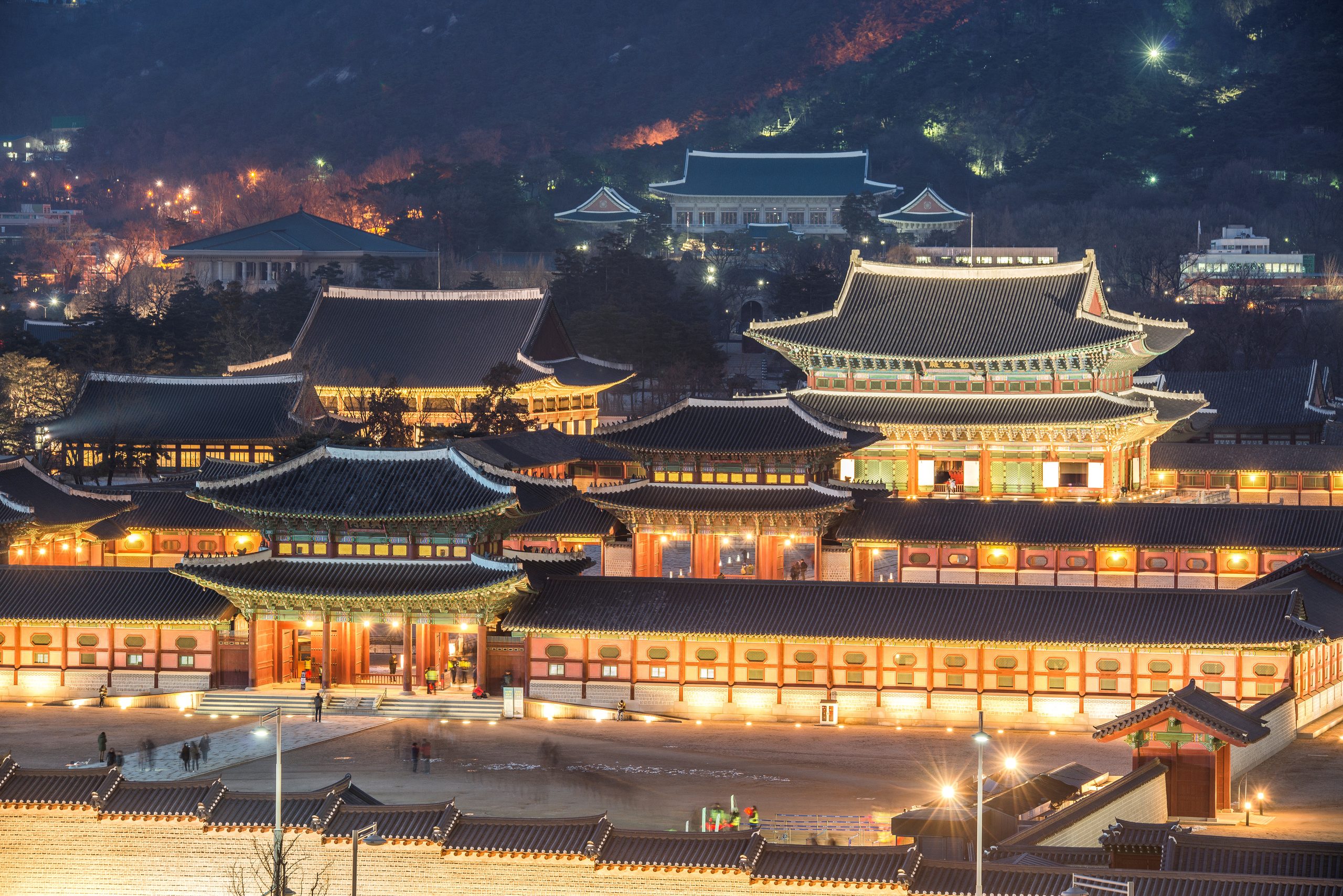
Gyeongbokgung after Dark
Gyeongbokgung’s night opening runs one month each season — the hard part is the ticket.
Gyeongbokgung night opening 2026, at a glance
In shortGyeongbokgung’s night opening (경복궁 야간관람) runs twice a year, about a month each spring and autumn — in 2026, 13 May–14 June and 2 September–2 October; the next run is spring 2027, dates not yet announced. It opens 19:00–21:30 (last entry 20:30), closed Mondays and Tuesdays. Tickets cost ₩3,000. Without a Korean phone number, buy one of the 300 on-site tickets at the Gwanghwamun ticket office with your passport, or wear hanbok and walk in free.
- Dates spring & autumn, every year
- Spring13 May – 14 Jun 2026Autumn2 Sep – 2 Oct 2026NextSpring 2027 · TBA
- Hours
- 19:00 – 21:30Last admission 20:30
- Closed
- Mon & TueEvery week of the run
- Admission
- ₩3,000₩1,500 ages 7–17 · free in hanbok
- Daily capacity
- ~3,000 online+ 300 on-site for foreign visitors
- Nearest station
- GyeongbokgungLine 3, Exit 5 — about 8 min on foot
It happens every year. Two runs a year, about a month each — so if you miss one, the next is a season away. Only the exact dates move, and they are announced a few weeks ahead. 🗓️
Daytime Gyeongbokgung is a bright, wide, slightly overwhelming place — granite courtyards baking in the sun, tour flags moving in blocks. At night it becomes a different building entirely. The floodlights are aimed upward into the eaves, so the dancheong — the green-and-vermilion painted joinery under the roof — reads as the brightest thing in the frame, and everything below it falls away into the dark. 🏮
The palace only does this for about a month in spring and a month in autumn — Koreans call it 경복궁 야간관람, the Gyeongbokgung night viewing. Tickets are genuinely competitive: the online release sells out in minutes, mostly to Korean residents who can clear the phone-verification step. But there are two other doors, and both of them are open to you. One of them is free.
The night we walked in
There is something faintly illicit about it — a place you can normally only enter in daylight, standing open at ten past seven on a weekday evening, and the two of us going through the gate with the slightly guilty excitement of people who have found a door left unlocked. 🗝️
My wife and I had been to Gyeongbokgung plenty of times. At night it was not the same building. However many people are there, the feeling after dark is nothing like the feeling by day.
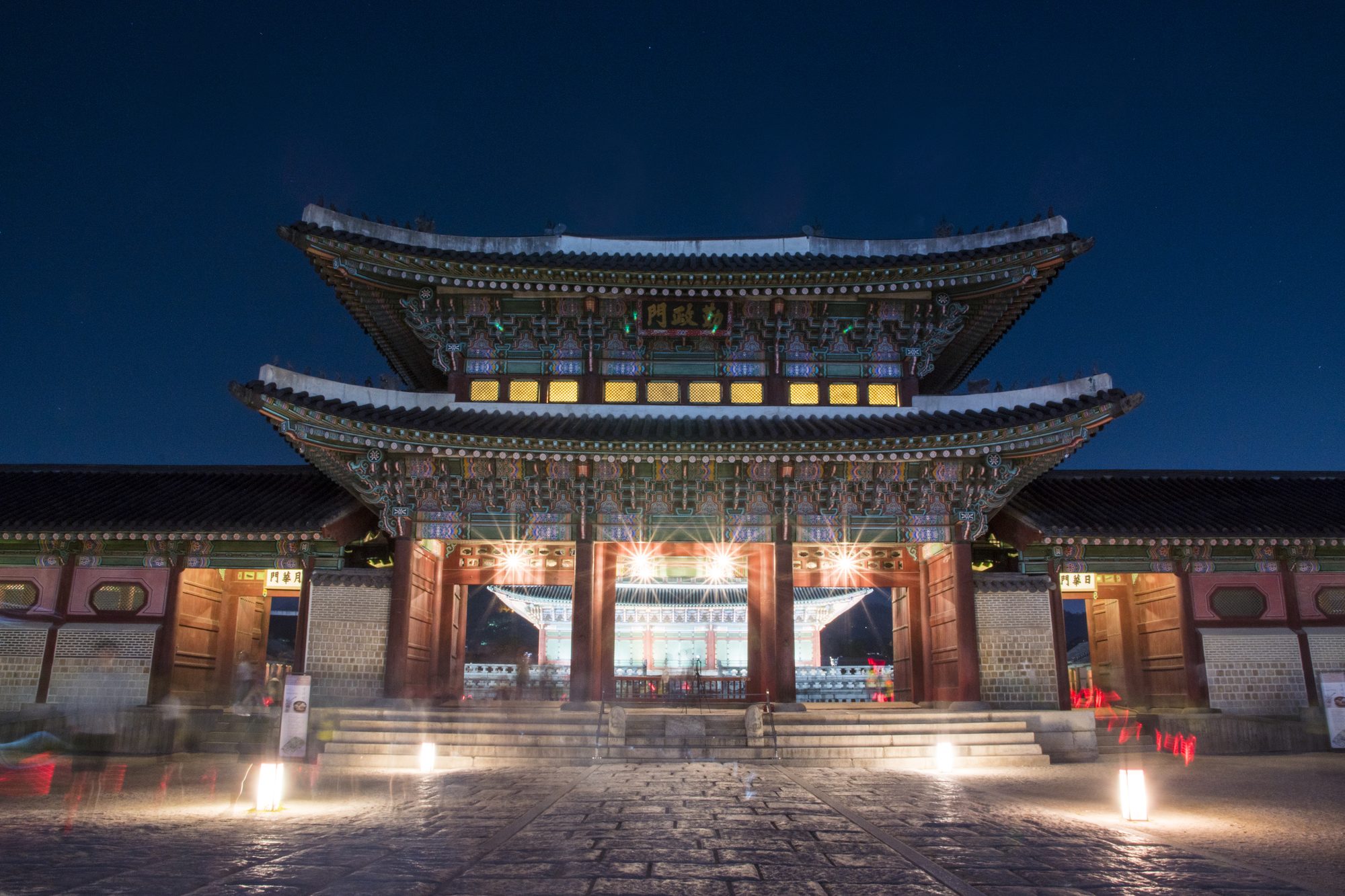
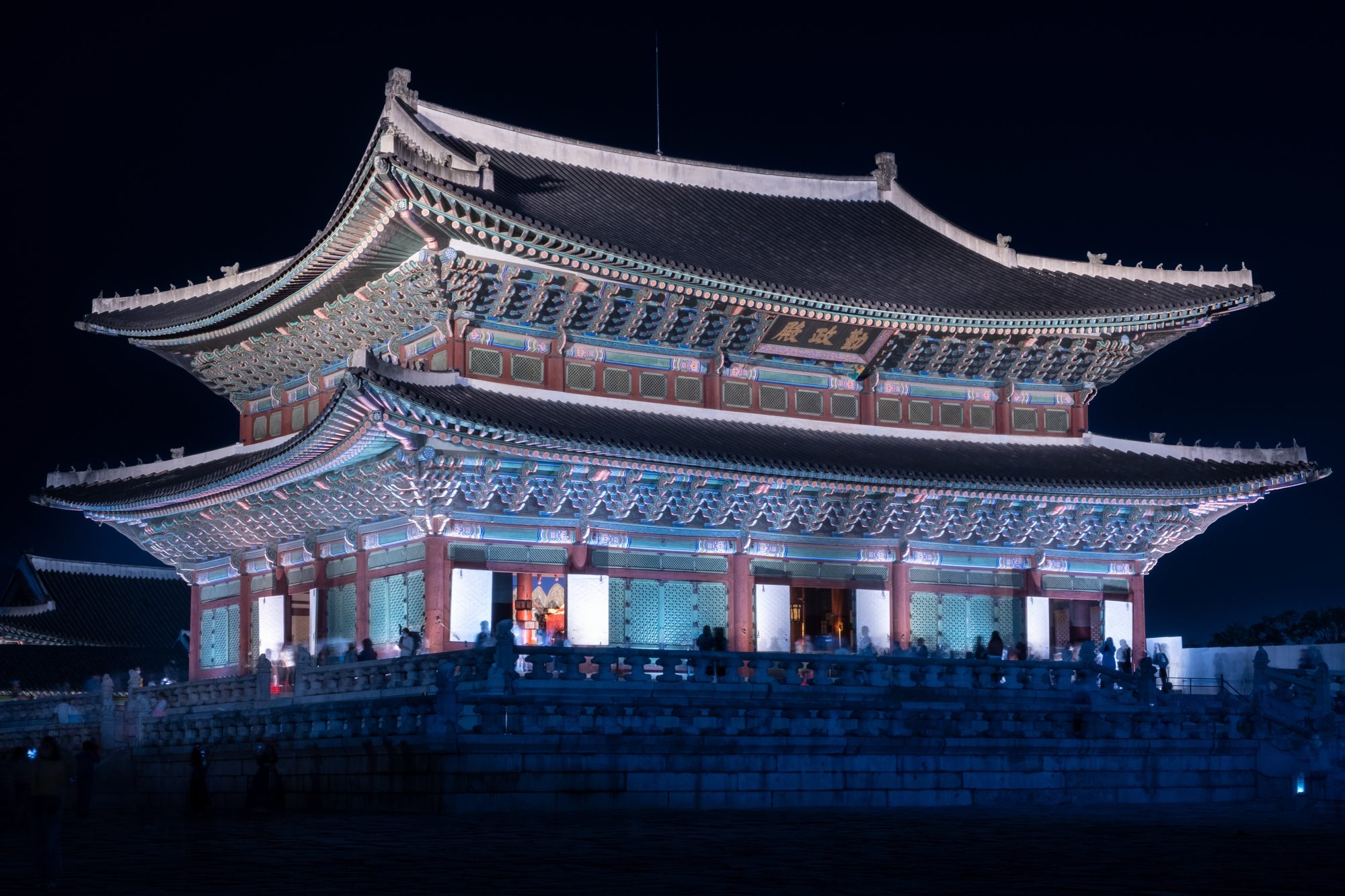
Geunjeongjeon under its soft uplighting, and the old halls behind it, looked stranger and more secretive than they ever do in the sun. Red columns and tiled roofs running on under a black sky — for a moment you are standing inside a scene from the Joseon dynasty.
In the quieter corners all you can hear is footsteps and low conversation, and time seems to slow down. There were plenty of people there to take photographs, and yet it never felt crowded so much as shared — a few thousand people agreeing to enjoy the same night.
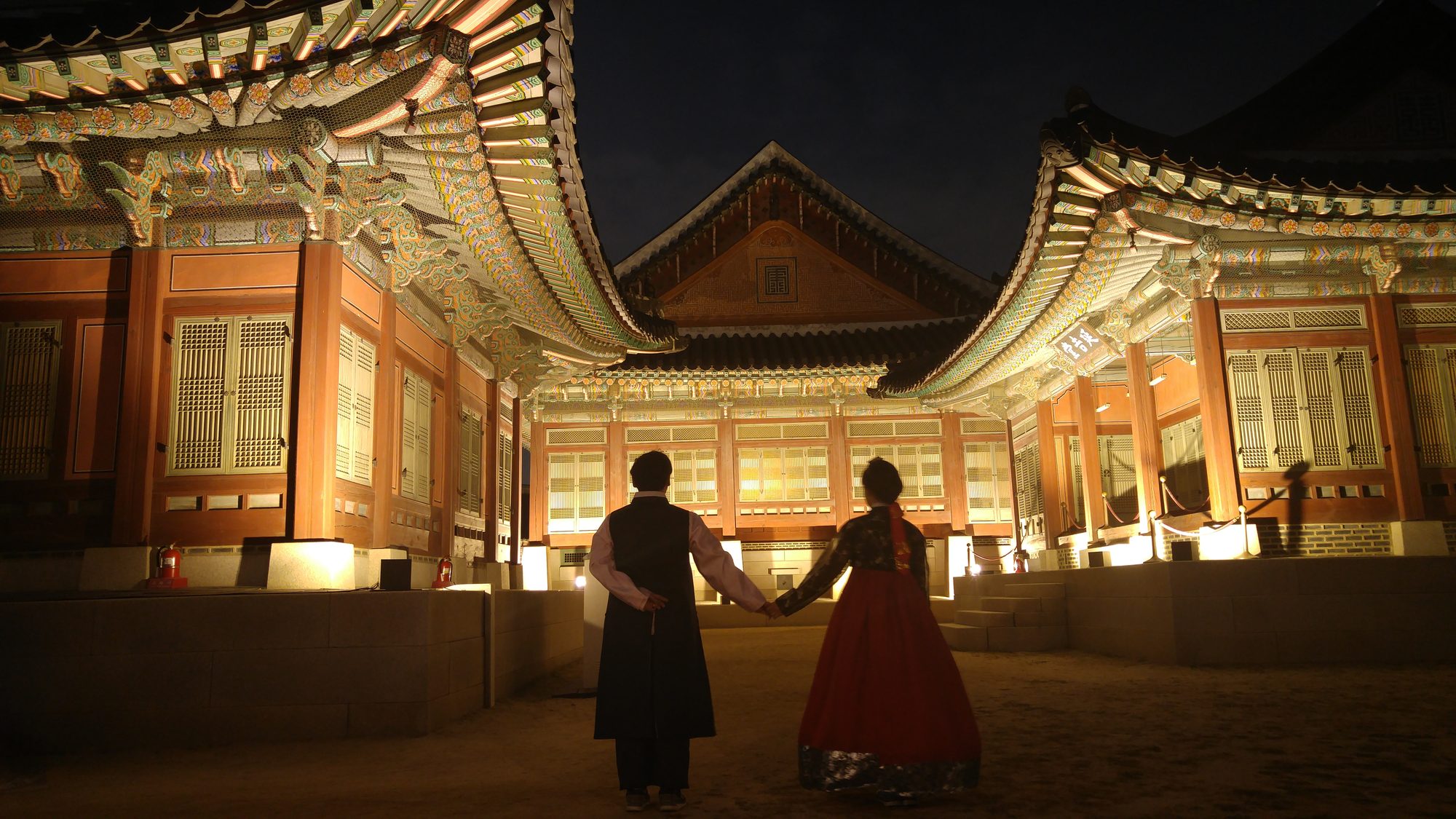
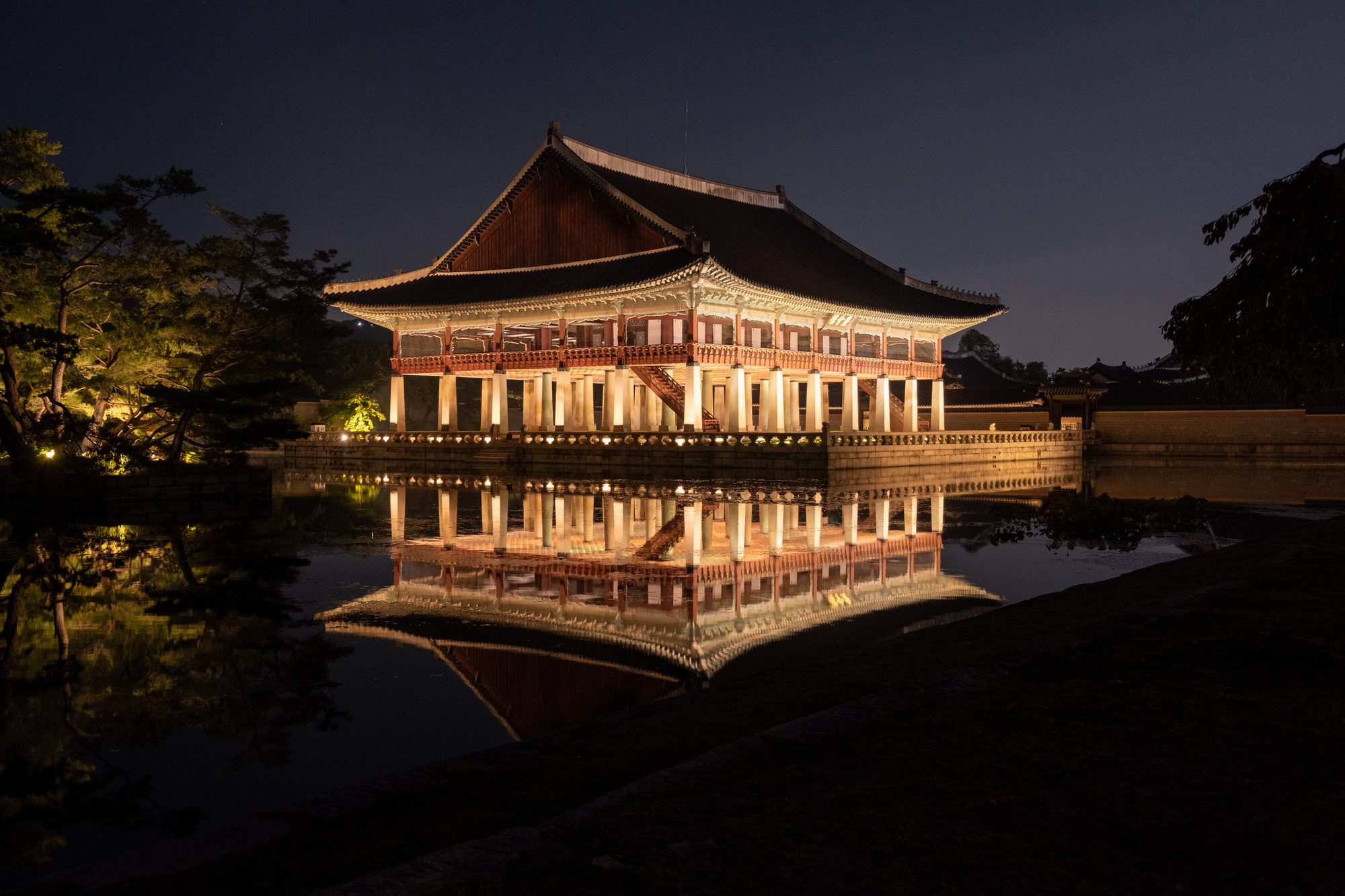
Walking slowly with my wife, finding things we had never noticed in daylight, was its own pleasure. And when you look past the dark palace to the lights of Seoul standing behind it, the past and the present seem to be occupying the same space. 🌃
The night opening is less an evening of looking at an old palace than a couple of hours of looking at a familiar place with new eyes. By day it is the scale that reaches you first. At night it is the quiet, and the fineness of the detail.
We walked slowly and the time went, and the mood of that night was still with us on the way home. Once, at least, it is worth walking the palace after dark and meeting a different building entirely.
How to get in: three ways through the gate
Ranked here by how realistic each one is for a visitor without a Korean phone number.
Route 01 · Most reliable
The 300 on-site tickets
Each night, 300 tickets are held back at the Gwanghwamun ticket office for foreign visitors only. No reservation, no Korean phone number — just a queue.
- 🛂Bring your passport or alien registration card
- Maximum 2 tickets per person
- Booth opens around 18:30; first come, first served
- ₩3,000 per adult, cash or card
Do this: arrive by 18:00 on a weekday, 17:15–17:30 on a Friday, Saturday or holiday week.
Route 02 · Free
Wear hanbok
Anyone in hanbok enters free, with no reservation — and the hanbok entrance keeps working even on nights that are officially sold out. 👘
- A full set: top and bottom together
- Modernised saenghwal hanbok counts
- Go to the ticket booth, not the online queue
- Rentals near Exit 4 and in Samcheong-dong run roughly ₩15,000–30,000 for two to four hours, and many stay open late during the run
Do this: rent by 17:30, so you’re dressed and at the gate before the 19:00 opening.
Route 03 · Hardest
The online release
About 3,000 tickets a night go on sale in one batch through NOL (Interpark) Ticket, weeks before the run. For autumn 2026 that was 10:00 on 26 August.
- Maximum 4 tickets per person
- Needs Korean identity verification and a domestic payment method
- Weekend and Chuseok-week dates go first
- Cancellations do reappear — check late at night
Do this: only if you have a Korean-resident friend willing to book and accompany you.
Children aged 6 and under, visitors aged 65 and over, holders of a Korean disability registration card plus one companion, and national merit recipients all enter free — bring the relevant ID. Free entry still requires you to collect a ticket at the booth.
Ninety minutes inside Gyeongbokgung, in the order that works
The open route at night is a straight spine through the palace with one detour west to the pond. You could rush it in 45 minutes. Don’t — the whole point is standing still in places you were hurried through in daylight.
Where to start
- A Gwanghwamun Gate 광화문 Main entrance. The ticket office for the 300 on-site foreigner tickets is just inside. Google MapsNaver Map
- B Gyeongbokgung Station, Exit 5 경복궁역 5번 출구 Line 3. The exit opens into the palace grounds. Exit 4 is the side for hanbok rentals. Google MapsNaver Map
- C Gwanghwamun Station, Exit 2 광화문역 2번 출구 Line 5. A slightly longer walk, straight across Gwanghwamun Square to the gate. Google MapsNaver Map
19:00
Gwanghwamun 광화문
Enter through the main gate rather than the side entrance. The approach from Gwanghwamun Square, with Bugaksan black behind the roofline, is the establishing shot.
19:10
Heungnyemun & the courtyard 흥례문
Cross the stone bridge over Yeongjegyo. Look down at the water — the carved animals on the bridge are lit from below at night and are almost invisible by day.
19:20
Geunjeongjeon 근정전
The throne hall. Its doors are open at night and the interior is lit, so you can see the throne and the painted ceiling from the courtyard — something you cannot do in the daytime crush.
19:40
Sujeongjeon 수정전
Court music performances run here on selected evenings — see below. If you’re not catching a set, carry straight on west.
20:00
Gyeonghoeru 경회루
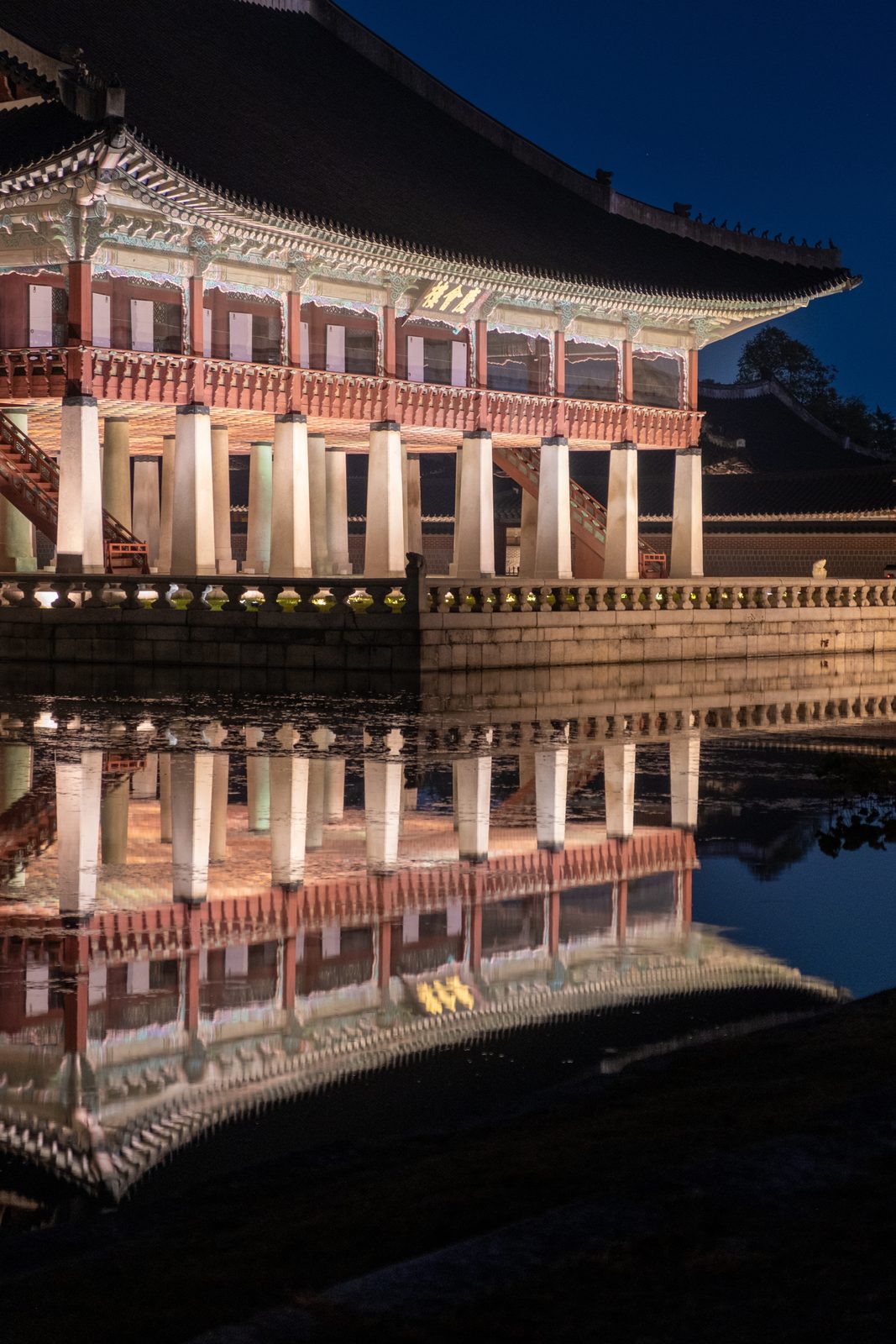
The banquet pavilion on its forty-eight stone pillars, doubled in the pond. This is the photograph everyone comes for, and the water is calmest before the 20:30 wave of last-admission arrivals.
20:30
Sajeongjeon → Gangnyeongjeon → Gyotaejeon 사정전·강녕전·교태전
The working hall and the royal sleeping quarters. Smaller, quieter, warmer light. Behind Gyotaejeon is Amisan, the queen’s terraced garden with its four brick chimneys.
21:15
Back out
Staff begin clearing from the far end at 21:15. Leave through Gwanghwamun and the whole façade is behind you, lit, with almost nobody left in front of it.
Court music at Sujeongjeon 수정전 🎵
On selected evenings during the run — mostly Thursday through Saturday — there are two free performances inside the palace, at 19:40–20:10 and 20:30–21:00. The programme mixes court dance, pansori narrative singing, and daegeum and gayageum pieces. It’s included with admission, seating is on the ground and limited, and people start gathering about fifteen minutes ahead. Check the schedule on the Korea Heritage Service palace site before you go, since the performance nights are announced per season.
Before you go
Getting there
Gyeongbokgung Station (Line 3), Exit 5, puts you inside the palace precinct; Exit 4 is the side for hanbok rental shops. Gwanghwamun Station (Line 5), Exit 2, is a slightly longer but more dramatic approach across the square.
What to bring
Your passport, whether or not you think you’ll need it. Something warm — the granite courtyards hold no heat and September evenings in Seoul drop fast after 20:00. Shoes you can stand in for two hours.
Photography 📷
Shoot handheld: professional equipment such as tripods requires a separate filming permit from the Korea Heritage Service, and the courtyards are too busy for one regardless. A fast lens and a steady wall will do more for you.
Where the light is
It depends on the season. In spring you go in while it is still light: sunset falls between about 19:30 in mid-May and 19:55 in mid-June, and the blue hour — deep blue sky against warm floodlights — runs roughly 19:50–20:15 in May and 20:15–20:40 by June. That is the time to be at Gyeonghoeru. In autumn it comes earlier: in early September you get about twenty minutes of blue hour after the 19:00 opening; by mid-September it is mostly over by 19:15, and from late September the sky is already dark when the gates open.
Eating after 🍜
The palace empties at 21:30 into Seochon, on the west side, where the small restaurants and bars off Jahamun-ro serve late. Samcheong-dong, to the east, closes earlier than visitors expect.
One caution ⚠️
Dates, performance nights and release times change every season. Confirm on the Korea Heritage Service royal palace portal before you build an evening around it.
Gyeongbokgung at night: frequently asked
Can I buy a Gyeongbokgung night ticket as a foreign tourist?
Yes. 300 tickets each night are reserved for foreign visitors and sold on-site at the Gwanghwamun ticket office, first come, first served. Bring a passport or alien registration card; the limit is two tickets per person and the booth opens around 18:30. The online release, by contrast, requires Korean identity verification.
Is entry really free if I wear hanbok?
Yes, and it works even on sold-out nights. You need a full set — top and bottom — and modernised saenghwal hanbok is accepted. Go to the ticket booth to collect your free ticket rather than queuing online. Rental shops cluster around Gyeongbokgung Station Exit 4 and in Samcheong-dong.
How much does the Gyeongbokgung night opening cost?
₩3,000 for adults and ₩1,500 for ages 7 to 17. Children under 6, visitors 65 and over, and registered disabled visitors with one companion enter free with ID.
When is the night opening held?
In 2026 the spring run was 13 May to 14 June and the autumn run 2 September to 2 October, open 19:00 to 21:30 with last admission at 20:30, closed every Monday and Tuesday. The exact dates shift each year and are announced a few weeks in advance.
What is the difference between the night opening and Byeolbit Yahaeng?
The night opening is general admission at ₩3,000 — you walk the main palace spine on your own. Byeolbit Yahaeng is a separate ₩60,000 guided tour of roughly 110 minutes that visits the normally closed northern precinct, including Jibokjae and Hyangwonjeong, and includes a twelve-dish court meal. It is booked by lottery on Ticketlink.
When is the next Gyeongbokgung night opening?
It runs twice a year, about a month each spring and about a month each autumn. In 2026 the runs were 13 May to 14 June and 2 September to 2 October, so the next run is spring 2027. Its dates are announced by the Korea Heritage Service a few weeks ahead on the royal palace portal (royal.khs.go.kr).
How long does a Gyeongbokgung night visit take?
About 90 minutes at an unhurried pace along the open route, from Gwanghwamun to Amisan, the queen’s garden behind Gyotaejeon. You can rush it in 45 minutes. Last admission is 20:30 and staff begin clearing at 21:15.
What time should I arrive for the on-site foreigner tickets?
By 18:00 on a weekday, and between 17:15 and 17:30 on a Friday, Saturday or holiday week. The Gwanghwamun ticket office opens around 18:30 and sells 300 tickets first come, first served, two per person, on presentation of a passport or alien registration card.
Can I bring a tripod to Gyeongbokgung at night?
Not without a separate filming permit from the Korea Heritage Service, and the courtyards are too crowded for one anyway. Shoot handheld. For blue hour, be at Gyeonghoeru around 20:00–20:30 in spring; in autumn it falls right after the 19:00 opening in early September and before it later in the month.
Is the Gyeongbokgung night opening worth it?
We think so. We had been to Gyeongbokgung many times by day; at night the lit eaves, the open throne hall at Geunjeongjeon and Gyeonghoeru doubled in its pond make it feel like a different place, and the crowd feels shared rather than crushing. At ₩3,000 — or free in hanbok — it is one of the cheapest memorable evenings in Seoul.
Byeolbit Yahaeng, the starlight tour Separate ticket from the night opening
The general night opening and the Starlight Night Tour are two different tickets, and people confuse them constantly. Byeolbit Yahaeng (별빛야행) is a small, guided, ticketed evening that goes into the palace’s northern precinct — the parts that stay closed on a normal night — and includes a court meal.
You walk from the outer royal kitchen through the storehouse courtyard to Jibokjae, the king’s library with its unmistakable Qing-influenced brick gable, then on past Palujeong to Hyangwonjeong’s island pavilion. The meal is a twelve-dish surasang served as a stacked lunchbox, eaten in the kitchen buildings with live court music. 🍱
- Price₩60,000 per person
- LengthAbout 110 minutes — sessions at 18:20 and 19:30
- RouteOesojubang · Janggo · Jibokjae · Palujeong · Hyangwonjeong
- BookingTicketlink, by lottery — enter during the application window, winners pay within a few days, unpaid seats are released first-come
- NoteVegetarian meals can be requested; seasons are announced separately from the general night opening