
Hangeul Day · 9 OctoberThe alphabet that got its own holiday
Every 9 October South Korea stops to celebrate a writing system. You can learn to read it in fifteen minutes, and the story starts with a king in Gwanghwamun Square.
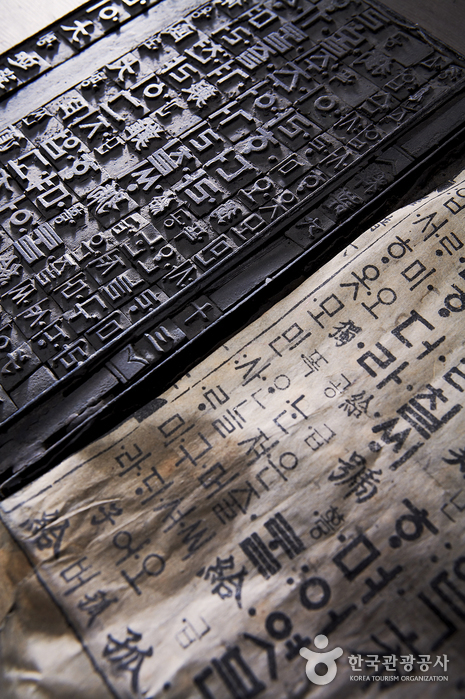
Movable type한글 금속활자Old Hangeul metal type locked in a frame, beside a page printed from type like it. Photograph: Korea Tourism Organization.
Photo · Korea Tourism Organization
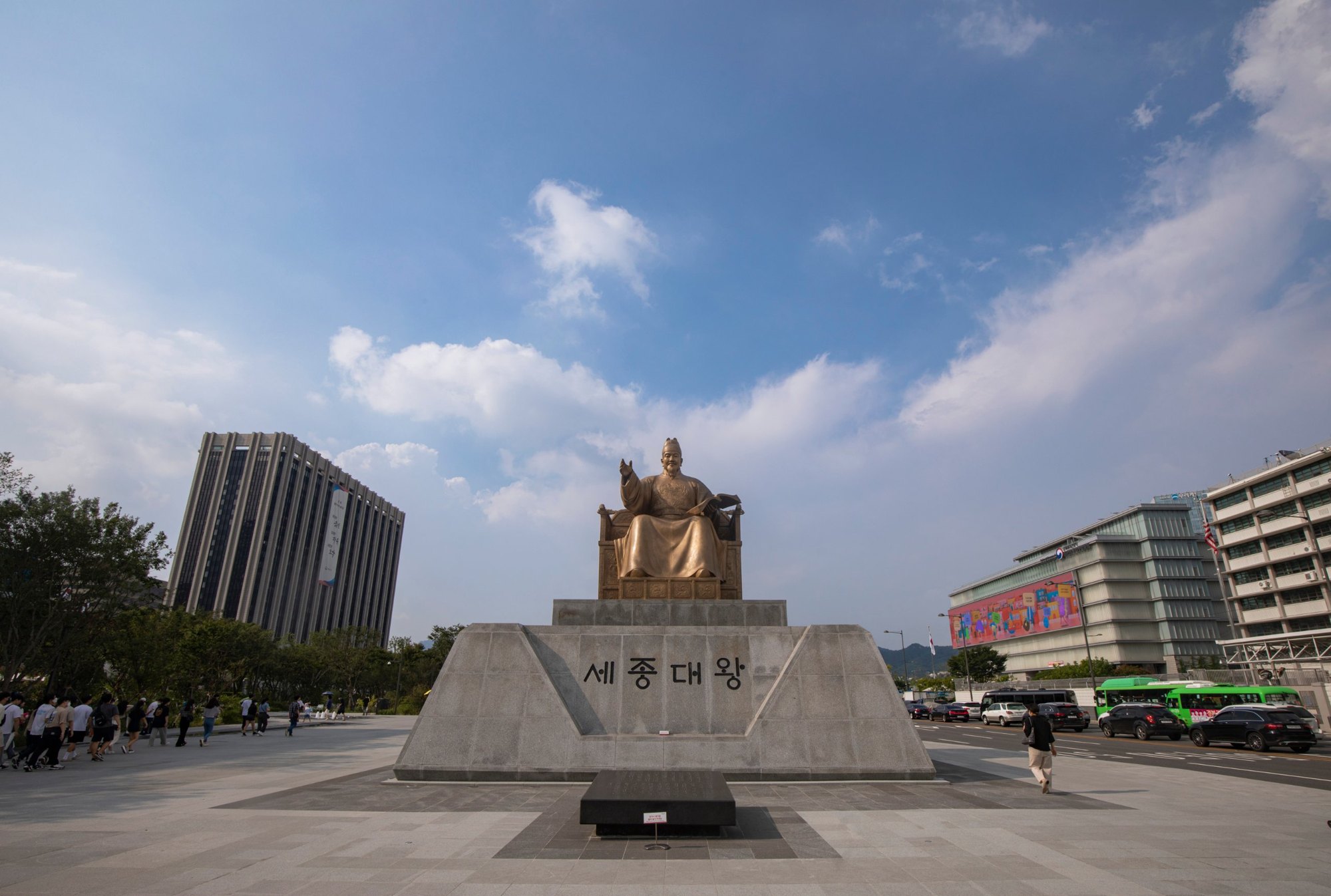
Joseon had two aliens. There is no other explanation. Between them they saw off an invasion, taught a kingdom to measure rainfall, and gave an entire people a way to write down what they actually said. Both are in Gwanghwamun Square today. One stands, and one sits.
The one standing is Admiral Yi Sun-sin, who fought the Japanese invasion fleets of the 1590s and kept winning. The one sitting is King Sejong the Great, and what he built was quieter and lasted longer: an alphabet.
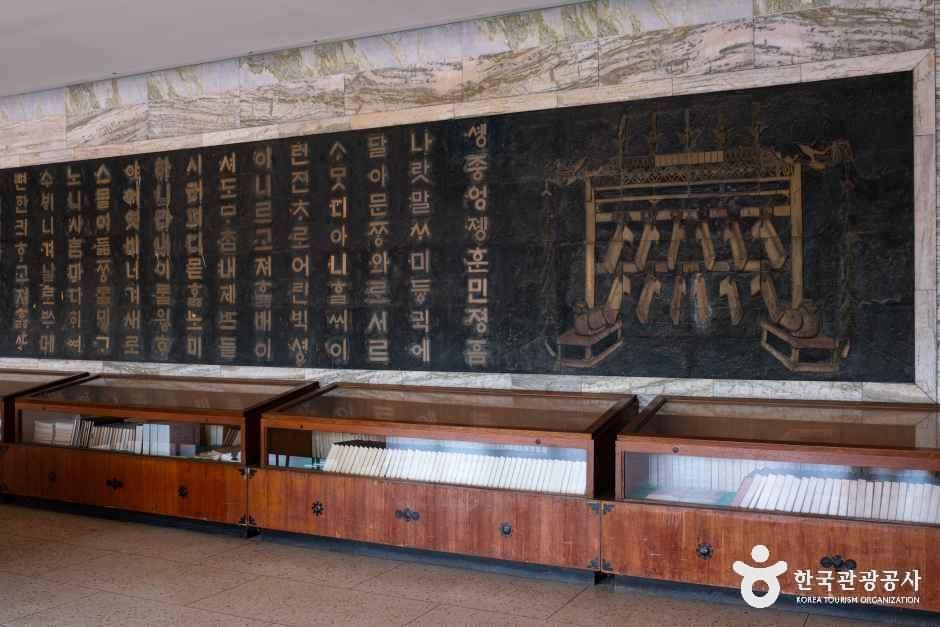
Sejong had it made in the winter of 1443 and announced it in 1446, in a short book called 훈민정음, Hunminjeongeum, “The Correct Sounds for the Instruction of the People.” Until then anyone who wanted to write used Chinese characters, thousands of them, learned over years for a language that sounds nothing like Korean. Reading belonged to the few who had the time. Sejong’s answer was twenty-eight letters, twenty-four in use today, shaped to match how Korean is spoken and simple enough to learn in days.
Hangeul Day in short ·
Hangeul Day (한글날) is 9 October, a South Korean public holiday that marks the 1446 announcement of Hunminjeongeum, King Sejong the Great’s guide to the Korean alphabet. Hangeul has 14 basic consonants and 10 vowels, stacked into one square block per syllable, so you can learn to sound it out in about fifteen minutes. In Seoul, start at the King Sejong statue in Gwanghwamun Square, visit the free Sejong Story exhibition beneath it, walk the Hangeul Garon-gil and finish in Insadong.
- Date9 October, every year
- Holiday1949–1990, and again since 2013
- Created1443 · announced 1446
- Letters24 in use (28 at first)
Why does Korea give its alphabet a holiday?
Because almost no other alphabet has a birth certificate.
Most writing systems drift into existence over centuries and nobody can say who drew the first letter or why. Hangeul is different. We know who made it, roughly when, and what he was trying to do. We also know how it works, because the explanation was written down at the same time, in a companion volume called the Haerye.
In his preface Sejong says, in short: the speech of this country is different from China’s, so ordinary people have things they want to say and no way to write them. He has made twenty-eight letters, hoping only that everyone can learn them easily and use them every day.
- 1443Sejong creates the letters, as recorded in the royal annals.
- 1446The alphabet is announced in Hunminjeongeum. The date Koreans celebrate comes from that book’s own dating, converted to the modern calendar.
- 1926The first public commemoration of the alphabet, organised by Korean-language scholars. The name Hangeul Day came soon after.
- 1949–1990A public holiday. It was dropped from the list in 1991 and brought back in 2013.
The proof that this is more than national pride comes from outside Korea. The original Hunminjeongeum Haerye manuscript has been on UNESCO’s Memory of the World Register since 1997.
UNESCO also gives out a prize in Sejong’s name. The King Sejong Literacy Prize, set up in 1989 with funding from Korea, goes every year to people and organisations that teach the world to read.
Read Hangeul in fifteen minutes
Hangeul is a system, not a pile of symbols. Fourteen basic consonants and ten vowels, most of them drawn from something you can picture.
You do still have to memorise the shapes. There is no way round that part. But once you have them, you can sound out almost every sign in Korea, and a surprising number of them are English words in disguise.
- Five minutes on consonants. Five of them are pictures of the mouth. The rest are those five with a stroke added.
- Five on vowels. Three shapes: a dot, a flat line and an upright line.
- Five on blocks and words. The letters stack into little squares. Then you read a few real signs.
Consonants are drawn from the mouth 👄
Sejong’s Haerye explains that the five basic consonants copy the shape of the mouth, tongue or throat as you say them. Look at the picture, then say the sound.
- ㄱ g / kback of the tongue rises and blocks the throat
- ㄴ ntongue tip touches the ridge behind the top teeth
- ㅁ mthe closed mouth, seen from the front
- ㅅ sa tooth, with air hissing past it
- ㅇ silent / ngthe throat, a round open tube
Add a stroke, add force ✏️
The other consonants are those five with an extra line. A stroke means a harder, breathier sound.
Plus one more, ㄹ, which sounds like an r and an l at once. Double a letter (ㄲ ㄸ ㅃ ㅆ ㅉ) and you get a tight, tense version of it.
Vowels are sky, earth and a person 🌏
Vowels come from three shapes: a dot for the sky, a flat line for the earth and an upright line for a standing person. Every vowel is a combination of them.
Put the dot beside the person and you get ㅏ, a. Dot on the other side: ㅓ, eo. Dot above the earth line: ㅗ, o. Dot below it: ㅜ, u. Two dots add a y sound.
Letters stack into blocks 🧱
This is the part that makes Hangeul look hard and turns out to be easy. Letters are not written in a line. They are packed into a square, one square per syllable: consonant first, then the vowel, with a closing consonant underneath if there is one. A vowel that stands tall goes on the right. A flat one goes below.
If a syllable starts with a vowel, a silent ㅇ holds the first slot. So ㅇ+ㅏ is simply 아, a.
가ga
vowel to the right
고go
vowel underneath
한han
closing consonant
곰gom, “bear”
all three stacked
Here is the whole set in one place. Fourteen consonants and ten vowels, with the sound to say beside each.
Words you will actually meet
Time to use it. These are the words a visitor sees every day, in the order you will probably run into them.

Place names are made of small parts 🪧
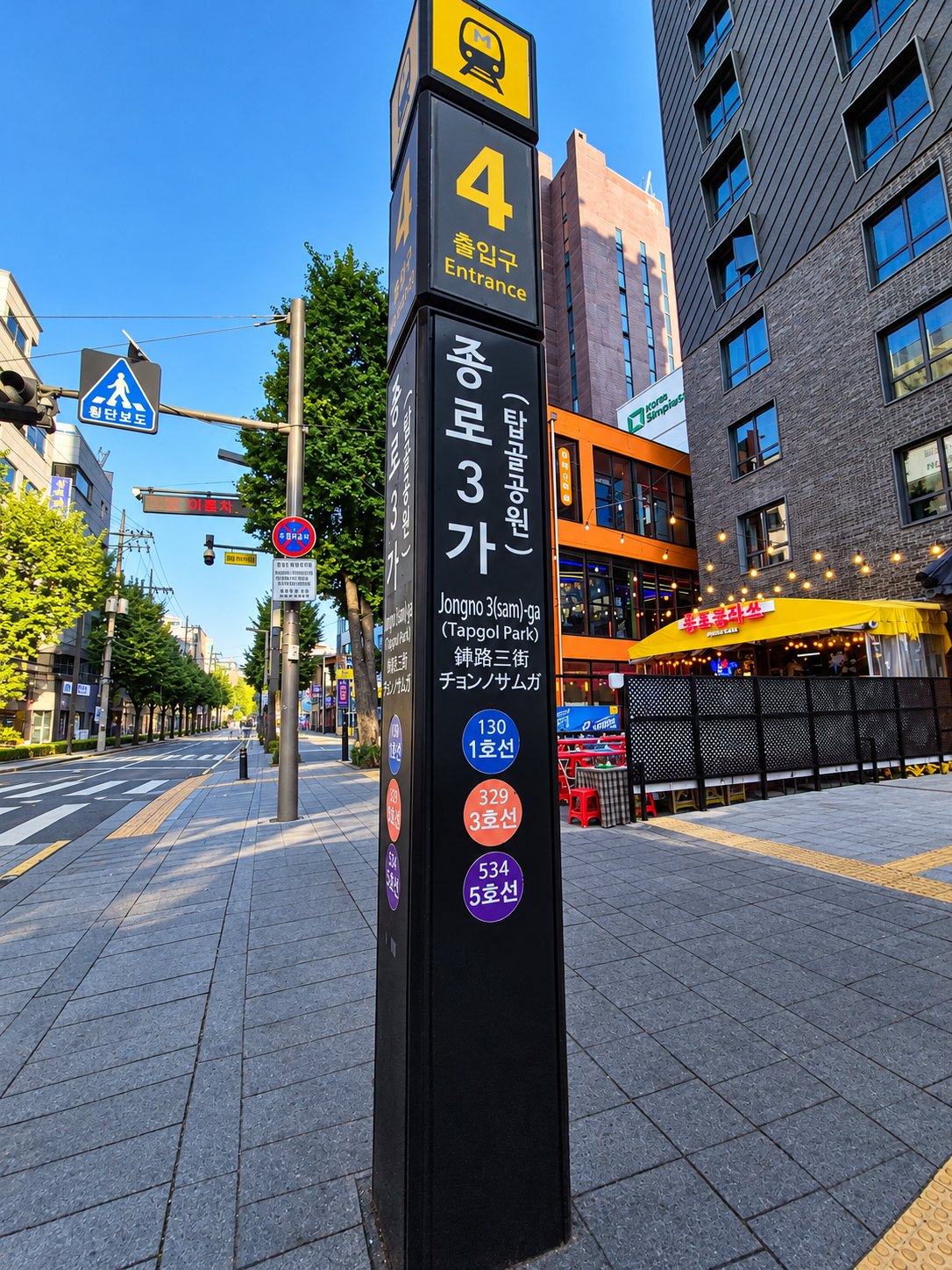
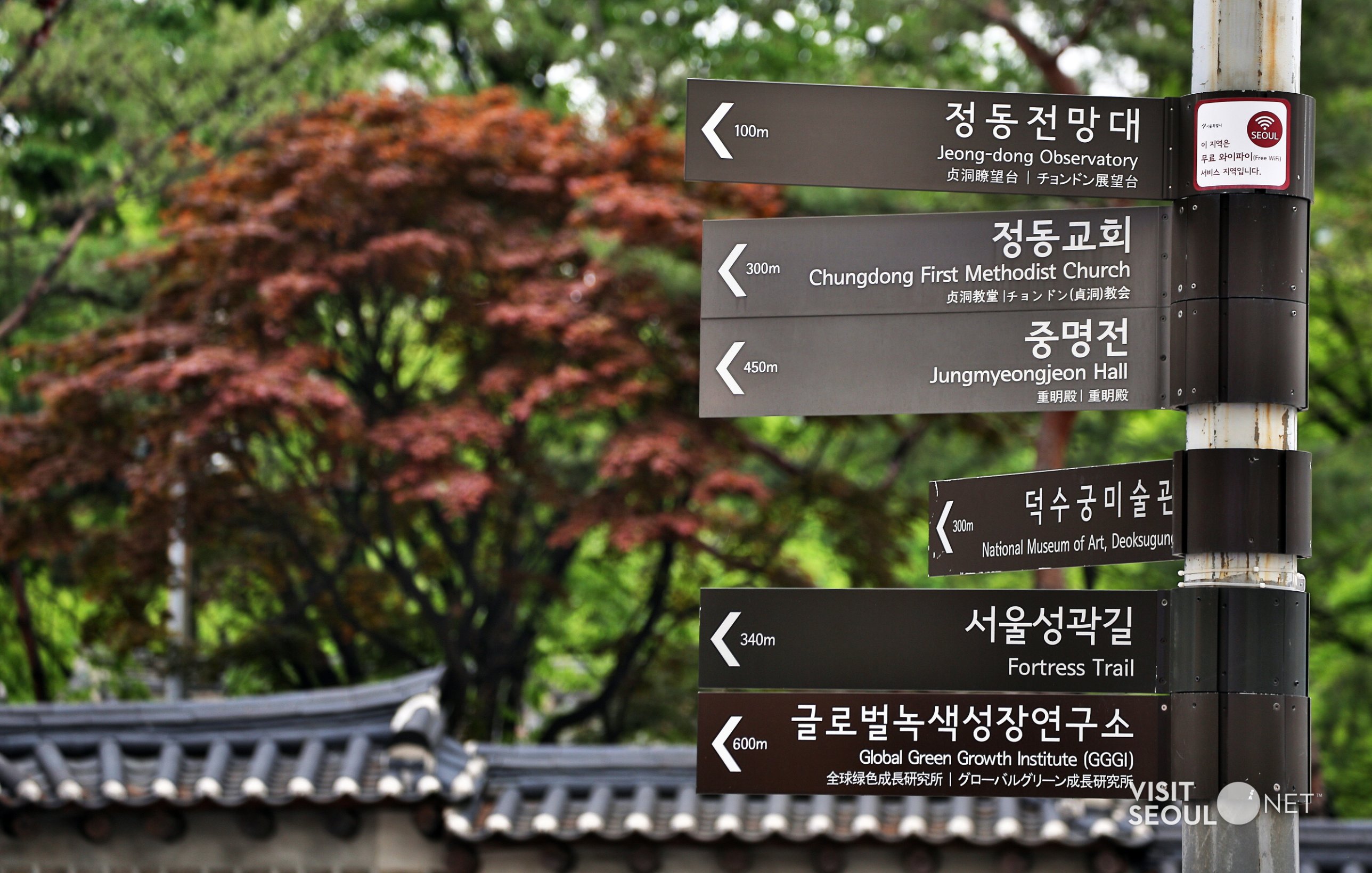
Look at a signpost and the endings repeat. Learn six and you can tell a palace from a church from a road before you can read the rest.
This sign is in Jeong-dong, beside Deoksugung. Every line has Hangeul on top and English underneath, so you can check yourself.
A cheat: you can already read these ☕
A lot of everyday Korean is English, spelled with Hangeul letters. Sound these out and see.
- 커피 — keo-pi. Coffee.
- 택시 — taek-si. Taxi.
- 호텔 — ho-tel. Hotel.
- 버스 — beo-seu. Bus.
- 아이스크림 — a-i-seu-keu-rim. Ice cream.
Write your name in Hangeul
Korean does not have a letter for every English sound, so foreign names are re-spelled by ear. Type yours and see how it would be written.
Try:
How it is built
Other spellings
Press and hold the picture (or right-click it) to save.
Roughly 700 common first names and surnames come from a list of how Koreans actually write them. Anything else is sounded out by rules, which is a good first draft and nothing more. If your name has several spellings, the buttons under “Other spellings” swap them in. Nothing you type leaves this page.
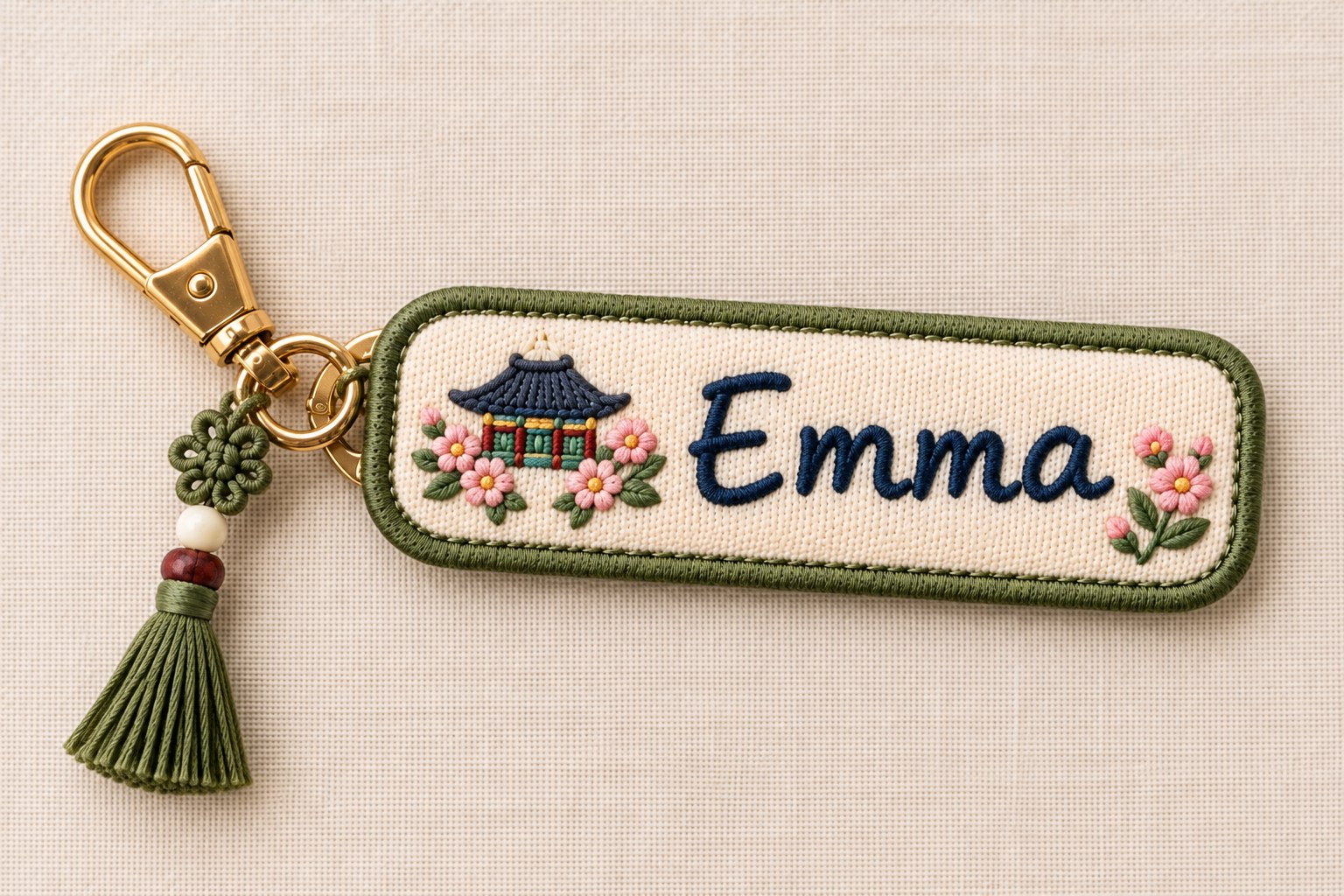
Take it home 🎁
Seeing your name is fun. Writing it is better. The Sejong Story exhibition under the statue has run hands-on corners where visitors write their name with a brush and take it away as a card, badge or nameplate. Programmes change, so check what is on when you go.
Or save the picture above and show it to the person behind the counter at any stationery shop. It makes a very good conversation starter.
Where to celebrate Hangeul Day in Seoul
Three stops are close enough to do on foot in a morning or afternoon: the statue, the trail of small monuments around it, and the old streets of Insadong.
Two more are further out and worth a separate trip: the National Hangeul Museum in Yongsan and the King Sejong Memorial Hall in the east of the city.
Map. Station positions come from public subway data; streets and buildings are placed from approximate coordinates, not a survey. Use + and − (or pinch) to zoom, drag to move. The dotted line is the Hangeul Garon-gil; its stops are lettered a–e as in the list below.
- King Sejong statue, Gwanghwamun Square 광화문광장 세종대왕 동상172 Sejong-daero, Jongno-gu · Gwanghwamun Stn (Line 5)Start here. The statue is the centre of the square, with Admiral Yi Sun-sin’s further south. On 9 October the square usually hosts Hangeul Day events beside it.Google directionsNaver map
- Sejong Story 세종이야기Underground, entered behind the statue · freeAn exhibition on Sejong’s life and the making of Hangeul, now expanded to include Admiral Yi and renamed Sejong and Chungmugong Story. Last time we checked it opened around 10:00 to 18:30 and closed on Mondays. Confirm before you go.Google directionsNaver map
- Hangeul Garon-gil 한글가온길A walking trail west of the square · freeA string of small monuments and plaques about the scholars and campaigners who protected Hangeul, running from the statue towards Hangeul Hall. The next section lists the stops in order.Google directionsNaver map
- Insadong 인사동Insadong-gil, Jongno-gu · Anguk Stn (Line 3)Galleries, tea houses and paper shops on a pedestrian street. Hangeul turns up everywhere, down to the big-name coffee chain that writes its sign in Korean letters.Google directionsNaver map
The Garon-gil, stop by stop 🚶
- King Sejong statue 세종대왕 동상The start.
- Hangeul Letter Square 한글글자마당A black, dice-like monument west of the statue.
- Sejong Art Park 세종 예술의 공원Behind the Sejong Center, with a sculpture called the Tree of Peace and Reconciliation.
- Ju Si-gyeong Plaza 주시경마당A small park with a carved panel about Ju Si-gyeong, the scholar who spent his life on Hangeul research, and the missionary Homer Hulbert.
- Hangeul Hall 한글회관Ju Si-gyeong’s statue stands out front. The storyboard panels across the street close the walk.
Further out 🚇
5 · National Hangeul Museum 국립한글박물관. In Yongsan, near Ichon Station. It is the national museum of the alphabet, free to enter, with a shop whose Hangeul-lettered stationery and keepsakes are worth the trip on their own. Check opening days before you go.
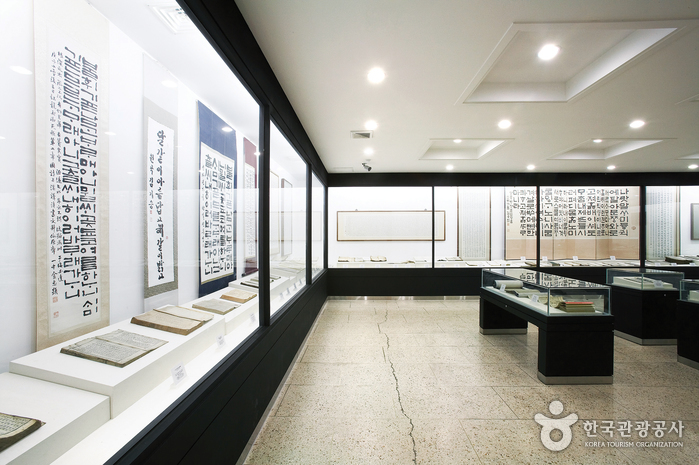
6 · King Sejong the Great Memorial Hall 세종대왕기념관. 56 Hoegi-ro, Dongdaemun-gu. It opened on Hangeul Day in 1973 and has four exhibition rooms: Sejong’s biography, Hangeul, science (including his rain gauge and sundial) and music.


Walking times are rough, from the statue, at a relaxed pace. Events on 9 October change every year. For the centennial in 2026, marking a hundred years since the first public Hangeul Day, the city programmed a day of hands-on activities beside the statue; check the Seoul city site for this year’s schedule.
Hangeul Day: quick answers
When is Hangeul Day?
Hangeul Day (한글날) is on 9 October every year. It is a public holiday in South Korea: it was one from 1949 to 1990, was dropped in 1991 and became a public holiday again in 2013.
Why is Hangeul Day on 9 October?
The date comes from Hunminjeongeum, the 1446 book in which King Sejong announced the alphabet. The date written in that book, converted to the modern calendar, falls on 9 October.
Who invented Hangeul?
King Sejong the Great of Joseon. He had the letters made in the winter of 1443 and announced them in 1446, so that ordinary people could write the Korean they actually spoke instead of using Chinese characters.
How many letters are in the Korean alphabet?
Twenty-four are in use today: 14 basic consonants and 10 basic vowels. Sejong’s original set had twenty-eight; four have dropped out of use.
Can you really learn to read Hangeul in 15 minutes?
You can learn to sound it out. Five consonants are drawn from the shape of the mouth and the rest add strokes to them; vowels are built from a dot, a flat line and an upright line; and letters stack into one square block per syllable. Memorising the shapes takes practice, but the system itself fits in fifteen minutes.
How do I write my name in Korean?
Foreign names are spelled in Hangeul by ear, following how they sound. The name tool on this page shows the spelling Koreans commonly use for about 700 first names and surnames, and sounds out anything else by rule as a first draft.
Where can I celebrate Hangeul Day in Seoul?
Start at the King Sejong statue in Gwanghwamun Square, where Hangeul Day events are usually held on 9 October. Go underground behind the statue to the free Sejong Story exhibition, walk the Hangeul Garon-gil trail west of the square, and finish in Insadong. Further out are the National Hangeul Museum in Yongsan and the King Sejong the Great Memorial Hall in Dongdaemun-gu.
Is the Sejong Story exhibition free?
Yes. Sejong Story, now called Sejong and Chungmugong Story, is free and entered from under Gwanghwamun Square, behind the statue. When we last checked it opened around 10:00 to 18:30 and closed on Mondays; confirm before you go.
Is Hunminjeongeum a UNESCO heritage item?
Yes. The original Hunminjeongeum Haerye manuscript has been on UNESCO’s Memory of the World Register since 1997, and UNESCO’s King Sejong Literacy Prize, set up in 1989, is named after the king.
Photo credits
Some pictures are mine and some come from public archives. Each is used under the licence noted. Pictures marked “unaltered” are shown whole, as the licence requires.
- Hero: movable type and early printed page — Korea Tourism Organization · KOGL Type 1 (attribution)
- King Sejong statue, Gwanghwamun Square — Korea Tourism Organization · KOGL Type 1 (attribution)
- Hunminjeongeum wall, Sejong Memorial Hall — Korea Tourism Organization · KOGL Type 1 (attribution)
- Sejong statue, Memorial Hall lawn — Korea Tourism Organization · KOGL Type 1 (attribution)
- Hangeul room and rain-gauge garden — Korea Tourism Organization · KOGL Type 3 (unaltered)
- Jeong-dong signposts — Visit Seoul · KOGL Type 3 (unaltered)
- Restroom sign and Jongno 3-ga pillar — Jisup Shin
- Name tag — illustration, not a photograph
Facts come from Seoul Metropolitan Government pages, the Dongdaemun-gu office and press reports; the UNESCO details are as they are widely published. Subway station positions come from the open SeoulMetropolitanSubway dataset on GitHub; streets on the walk map are placed from approximate coordinates, not survey data. Transliterations of names are a best guess and may differ from the spelling Korean friends would pick.