Gloved hands spreading red chili paste between salted napa cabbage leaves during Gimjang, Korea's late-autumn kimchi-making
← Gastronomy

Korean Food by SeasonEat Korea
in its season

Spring greens, summer melons, the autumn harvest and winter’s cold-water seafood — the Korean food you can only meet when the calendar allows.

Scroll Down

Gimjang김장 Each late autumn, families salt cabbages by the hundred and fill them with chili paste, together — enough kimchi to carry the house through winter.

A note before you sit down

Every season in Korea brings food you simply have to eat.

Living through four seasons in Korea keeps you busy. We call these Jecheol (제철) foods: ingredients eaten at the exact moment they are at their best. Let a season slip by without them and something always feels missing, a small regret you carry until the year comes round again.

So when you travel here, don’t only order the dishes you already know. Sit down, and ask what the Jecheol dish is. It is the surest way to eat the best thing Korea has at that moment, often something you won’t find back home, and never quite the same outside its season.

I hope you go home having tasted Korea at its most delicious, whenever it was that you came.

Jisup Shin

The Korean food calendar

What to eat in Korea, season by season

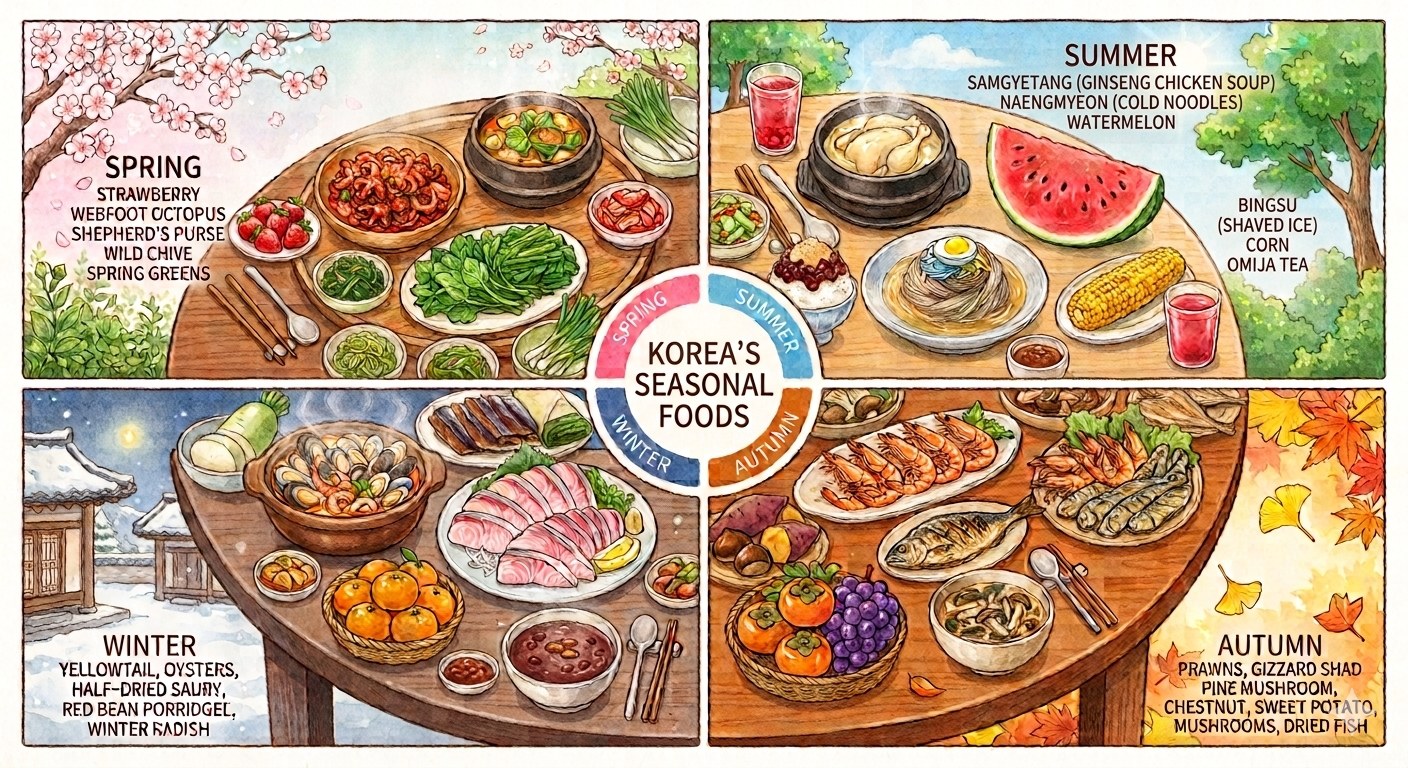
One round table, set four times a year. Here’s the whole year on it. Find the season you’re coming in, then read on for what I’d eat.

Illustrated round tables showing Korea's seasonal foods: spring greens, strawberries and baby octopus; summer samgyetang, naengmyeon, watermelon and bingsu; autumn prawns, gizzard shad, chestnuts, sweet potatoes and persimmons; winter yellowtail, oysters, half-dried saury and red bean porridge
Korea’s seasonal table at a glance
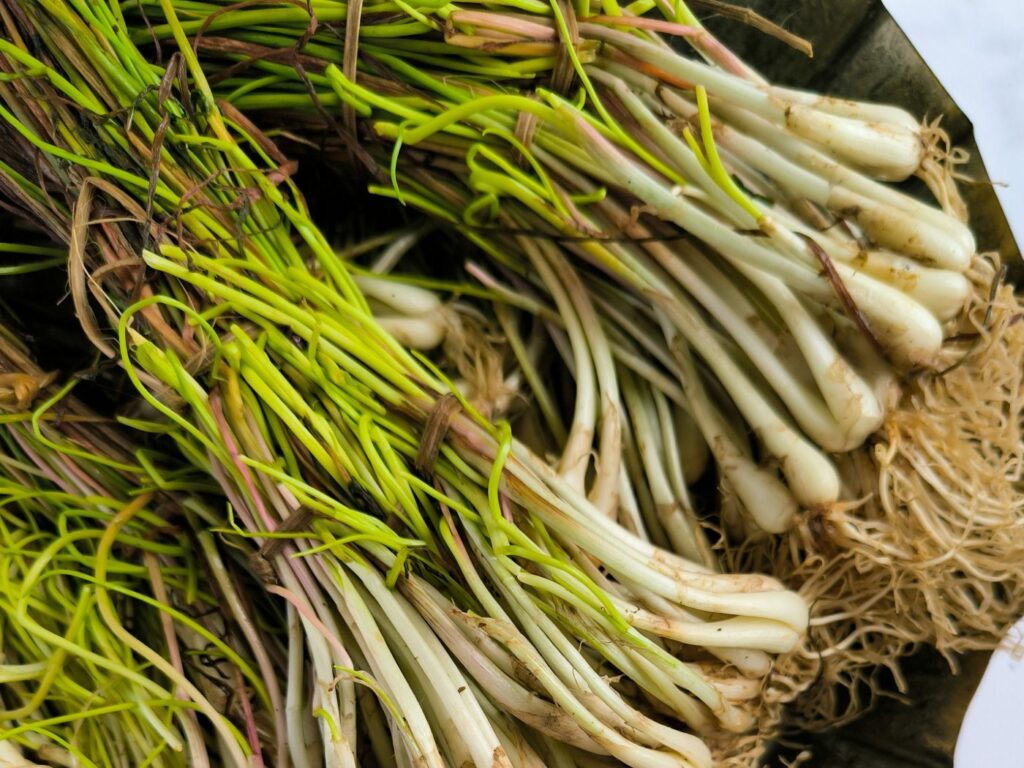
Bundles of fresh dallae, Korean wild chive, with their white bulbs and roots

March – May

Spring food in Korea

봄 · bom

Tender shoots and wild greens push up through ground that was frozen only days ago. Dallae (wild chive) and Dureup (angelica shoots) smell of fresh grass and are my favourite vegetables of the year, and a handful of Naengi, shepherd’s purse, in a bubbling doenjang stew tastes like the season itself.

Korean strawberries, I’d argue, are the best in the world. And if you like things chewy and hot with spice, find a plate of Jjukkumi, stir-fried baby octopus.

  • Dallae
  • Dureup
  • Naengi
  • Strawberries
  • Jjukkumi
Korean Chamoe yellow melons, a summer fruit

June – August

Summer food in Korea

여름 · yeoreum

Kongguksu, chilled soybean noodle soup, and shaved-ice Bingsu are half the reason I look forward to the heat, with a bowl of icy Naengmyeon close behind. The Honey One melon is sold only in a short window at the start of summer. As far as I know, no other country has a melon this good.

Grab steamed corn from a roadside stall, cool off with ruby-red Omija tea, and on the hottest day do as Koreans do: fight heat with heat over a bowl of Samgyetang, ginseng chicken soup.

  • Kongguksu
  • Bingsu
  • Naengmyeon
  • Honey One melon
  • Samgyetang
Golden rice ready for the autumn harvest, the source of new-crop haessal

September – November

Autumn food in Korea

가을 · gaeul

Autumn is when food is most abundant in Korea, and when seafood tastes best: Daeha prawns grilled on salt, Galchi hairtail, Godeungeo mackerel, and Jeoneo, gizzard shad, whose smell on the grill is said to bring anyone back home.

Songi pine mushrooms come down from the mountains, chestnuts and sweet potatoes go on the fire, and Hongro, my favourite apple, shows up only briefly. Korean pears are, I’d say, the finest anywhere.

  • Daeha
  • Galchi
  • Jeoneo
  • Songi
  • Hongro apple
  • Korean pear
Snow-covered Korean temple roofs with red persimmons on bare branches

December – February

Winter food in Korea

겨울 · gyeoul

When winter comes I always eat Gulgukbap, oyster rice soup, and a hot broth of Kkomak cockles and Honghap mussels makes you forget the cold outside. Fat Bangeo, yellowtail, is at its richest now, and Gwamegi, half-dried saury, is worth trying at least once. On the winter solstice we eat Patjuk, red bean porridge.

This is also when tangerines come in from Jeju Island. Peeling them on a warm heated floor is about as happy as it gets.

  • Gulgukbap
  • Kkomak
  • Bangeo
  • Gwamegi
  • Jeju tangerines

Say it at the table

Ask for what’s in season

요즘 제철 음식이 뭐예요? Yojeum jecheol eumsigi mwoyeyo? “What’s in season right now?”

FAQ

Eating seasonally in Korea: FAQ

How do I order seasonal food at a Korean restaurant?

Ask “Yojeum jecheol eumsigi mwoyeyo?” (What’s in season right now?). Many restaurants also write seasonal dishes on a paper sign or a whiteboard on the wall rather than in the printed menu, so look there first. At seafood restaurants, the tanks by the door show you what’s at its best that week.

When is the best time to visit Korea for food?

Any season has something worth the trip, but autumn (September to November) is the most abundant: seafood, mushrooms, new-crop rice, apples and pears all peak together. If you love seafood and hot soups, come in winter; for wild greens and strawberries, come in spring.

Can I find seasonal food in Seoul, or do I have to travel?

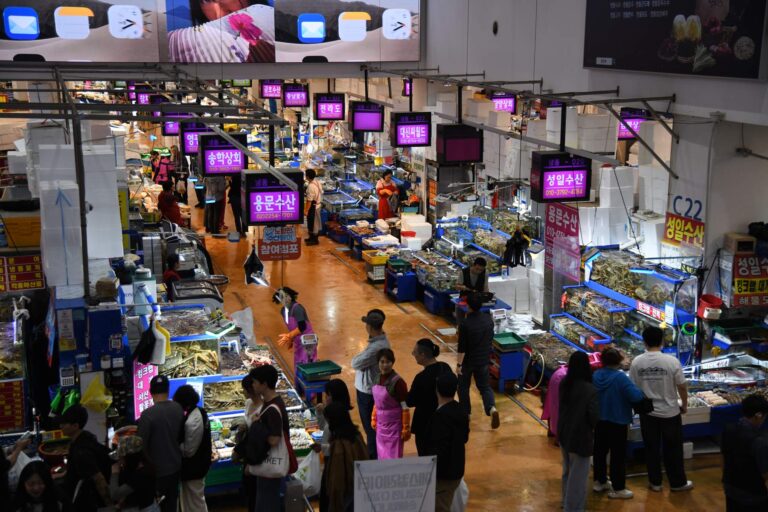
Seoul has almost everything. Traditional markets such as Gwangjang Market and the Noryangjin fish market are the easiest places to see what’s in season. Some things still taste best at the source, though: winter oysters in Tongyeong, Gwamegi in Pohang, and tangerines on Jeju.

Is seasonal food more expensive?

Usually the opposite. When something is in season there is plenty of it, so it is at its cheapest and its best at the same time. A few prized items, like Songi pine mushrooms or the first melons of summer, stay pricey even at their peak.

What is Gimjang?

Gimjang (김장) is the late-autumn tradition of making a whole winter’s worth of kimchi at once, usually around late November, with family and neighbours working together. It is on UNESCO’s list of the Intangible Cultural Heritage of Humanity. Some cultural centres and temple stays run Gimjang programmes that visitors can join.

I’m vegetarian. Can I still enjoy Korean seasonal food?

Yes, especially in spring, when wild greens (namul) are served simply seasoned, and in summer with Kongguksu and fruit. Be careful with soups and stews: many are made with anchovy or seafood stock even when they look vegetable-only, and most kimchi contains fish sauce or salted shrimp. Temple food restaurants are a safe choice.

Journal

Seasonal food stories from Korea

What each season brings to the table, one dish at a time.

Scroll to Top